MATH-181 (Calculus I) Curriculum
Session 06 - Rates of Change and the Definition of the Derivative
By the end of this session, you will be able to:
- Distinguish between average and instantaneous rates of change, estimate derivative values from graphs, and identify the four visual conditions where differentiability fails (corners, cusps, vertical tangents, and discontinuities).
- Compute instantaneous rates of change and algebraic derivative functions from scratch using the limit definition of the difference quotient across polynomial, rational, and radical functions.
- Construct linear tangent line equations using point-slope form () and evaluate the derivative as a general slope function for physical system linearization.
Micro-Lecture
1. Rates of Change & The Secant-to-Tangent Transition
- Mathematical Foundation: The average rate of change between two points on a curve corresponds to the slope of a secant line: (see Difference Quotient). As the interval width shrinks to zero (), the secant line rotates into the tangent line at . The limiting value of this difference quotient defines the instantaneous rate of change or derivative (see Derivatives).
- Engineering Context: Kinematic tracking in automotive and aerospace vehicles computes instantaneous acceleration from high-frequency GPS position pings, while biomedical telemetry monitors instantaneous pulse rate spikes during cardiovascular stress testing.
2. Formal Differentiability & Structural Failure Modes
- Mathematical Foundation: Differentiability at a point requires a finite, unique two-sided derivative limit. While differentiability guarantees continuity (), continuity does not guarantee differentiability (see Differentiability). Differentiability fails visually at sharp corners, cusps, vertical tangents, and points of discontinuity (see Discontinuities).
- Engineering Context: High-speed railway track junctions and highway ramps require continuous tangent slopes ( smoothness) to prevent violent lateral centrifugal acceleration spikes. In structural mechanics, internal sharp corners create non-differentiable stress concentration points where micro-cracks form, requiring smooth rounded fillets.
3. The Derivative Function & Tangent Line Linearization
- Mathematical Foundation: Evaluating the difference quotient limit with respect to the variable yields the derivative function , which outputs the instantaneous slope at any point along the curve. This slope enables the construction of the tangent line (see Tangent Lines).
- Engineering Context: Onboard autopilot flight controllers linearize complex non-linear aerodynamic flight dynamics around current operational waypoints, executing microsecond trajectory adjustments without overloading embedded processors.
Skill Block 1
Worked Example A: Graphical Derivative and Differentiability Analysis
Consider a piecewise function defined on with a vertical asymptote at , a sharp corner at , a straight line segment connecting to , and a jump discontinuity at from to .
- (a) Evaluate .
- (b) Identify all -values on where is continuous but NOT differentiable.
- Evaluate the derivative on the straight segment for :
Notice that lies on the straight line segment between and . On any linear segment, the instantaneous rate of change equals the constant slope of that segment:
- Identify points where is continuous but not differentiable:
Scan for points where the curve is fully connected (continuous) yet has no unique non-vertical tangent line:
- At , has a vertical asymptote (discontinuous non-differentiable).
- At , has a jump discontinuity (discontinuous non-differentiable).
- At , the graph forms a sharp V-shaped corner at . The function is continuous because the left and right paths meet at , but the left-hand incoming slope does not equal the right-hand outgoing slope.
- Conclusion: is continuous but non-differentiable at .
Practice Problem 1: Concept & Reading Check
Open this Skill Block on the Memex to locate the information needed to answer the following:
- (a) Under the Conceptual Framework section, explain why continuity is a necessary but not sufficient condition for differentiability.
- (b) In Worked Example A, explain why the derivative can be calculated directly using the standard slope formula .
- (c) Review the linked Engineering Applications ("High-Speed Railway Transition"). Why must the position profile of a high-speed railway track be differentiable ( exists) rather than merely continuous at track junctions?
- (a) As detailed in the Conceptual Framework, the theorem confirms that differentiability requires continuity. However, the converse is false because a curve may be connected without breaks (continuous) yet feature sharp corners, cusps, or vertical tangents where the two-sided limit of the difference quotient does not exist or is infinite.
- (b) For any linear segment , the difference quotient is constant for all . Thus, evaluating the derivative at simply equals the geometric slope .
- (c) In High-Speed Railway Transition (Civil Engineering), differentiability at ensures that the straight track seamlessly aligns with the curved bypass with an identical tangent vector (). If the derivatives mismatched, the resulting sharp corner would subject traveling train cars to infinite lateral jerk and severe centrifugal derailment hazards.
Practice Problem 2
Consider the graph of given below:
- (a) Find the following values:
- i.
- ii.
- iii.
- iv.
- v.
- vi.
- (b) State any horizontal and vertical asymptotes for .
- (c) Identify any points of discontinuity for AND indicate the type of discontinuity for each.
- (d) At which points, if any, is continuous but not differentiable? State the -value(s) and justify.
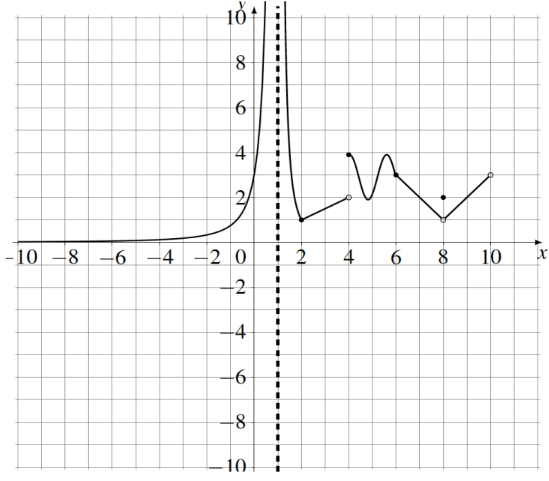
- (a) Graphical evaluations:
- i. because .
- ii. (curve rises indefinitely to the right of ).
- iii. (both paths approach the open hole at ).
- iv. (approaching the right endpoint).
- v. (horizontal asymptote along the -axis).
- vi. because on , the graph is a line segment through and : .
- (b) Asymptotes: Horizontal asymptote at as ; Vertical asymptote at .
- (c) Discontinuities:
- : Infinite discontinuity (vertical asymptote).
- : Jump discontinuity (one-sided limits are finite but unequal).
- : Removable discontinuity (hole at , with ).
- (d) Continuous but Non-Differentiable:
- and : At both coordinates, the graph is continuous (unbroken), but forms a sharp corner where incoming and outgoing slopes change abruptly. (Note: are also non-differentiable, but they fail continuity).
Regroup 1
- Clarify the geometric difference between secant lines and tangent lines.
- Reiterate why continuity is necessary for differentiability, but not sufficient (highlighting sharp corners and cusps).
Skill Block 2
Worked Example A: Polynomial Difference Quotient with Binomial Expansion
Compute the derivative for using the limit definition.
- Set up the difference quotient:
- Expand the numerator:
- Cancel non- terms:
- Factor out and divide it from the denominator:
- Evaluate by direct substitution ():
Worked Example B: Radical Difference Quotient with Conjugates
Compute the derivative for using the limit definition.
- Set up the difference quotient:
- Multiply numerator and denominator by the conjugate :
- Simplify the numerator via :
- Divide out and evaluate the limit as :
Practice Problem 3: Concept & Reading Check
Open this Skill Block on the Memex to locate the information needed to answer the following:
- (a) Under the Conceptual Framework section, why does direct substitution of in the difference quotient always produce , and what algebraic step eliminates this issue?
- (b) In Worked Example B, identify the algebraic conjugate used and explain how the difference of squares identity clears the square roots.
- (c) Review the linked Engineering Applications ("Inductor Transient Voltage"). How is the derivative of current related to induced voltage across an inductor?
- (a) As outlined in the Conceptual Framework, as , , so the numerator approaches while the denominator approaches . We must manipulate the expression until every term without an cancels, factor from the numerator, and divide it out with the denominator to evaluate the limit safely.
- (b) In Worked Example B, the conjugate of is . Using , the product becomes . This frees from inside the radical so it can be canceled with the denominator .
- (c) In Inductor Transient Voltage (Electrical Engineering), the induced voltage across an inductor is proportional to the rate of current change: . Computing the rational difference quotient for yields , producing .
Practice Problem 4
Use the limit definition of the derivative to find the derivative of the cubic polynomial:
- Set up the difference quotient:
- Expand and distribute constants:
- Cancel opposing non- terms:
- Factor out and cancel with denominator:
- Evaluate by direct substitution ():
Practice Problem 5
Use the limit definition of the derivative to find for the rational function:
- Set up the difference quotient:
- Find a common denominator for the numerator:
- Expand and simplify the numerator:
- Cancel from numerator and denominator:
- Evaluate by direct substitution ():
Practice Problem 6
Use the limit definition of the derivative to find the derivative of:
- Set up the difference quotient:
- Multiply numerator and denominator by the conjugate:
- Simplify the numerator:
- Divide out :
- Evaluate as :
Regroup 2
- Review common algebraic traps: sign distribution errors when expanding and dropping denominators in complex rational fractions.
- Emphasize checking units in physical rate problems (e.g., for mass flow, for inductor back-EMF).
Skill Block 3
Worked Example A: Constructing a Tangent Line from a Rational Curve
Using limits, find the equation of the line tangent to the function at .
- Find the point of tangency :
Evaluate the original function at :
- Find the slope via limit definition:
Combine the numerator over :Evaluate at :
- Assemble the tangent line equation using point-slope form:
Practice Problem 7: Concept & Reading Check
Open this Skill Block on the Memex to locate the information needed to answer the following:
- (a) Under the Conceptual Framework section, what three pieces of information are required to build a tangent line equation, and which equation is used for each?
- (b) In Worked Example A, explain why is computed using while the slope is computed using the limit .
- (c) Review the linked Engineering Applications ("Drone Flight Path Linearization"). Why do autonomous flight control systems utilize tangent line linearizations instead of exact nonlinear equations?
- (a) As explained in the Conceptual Framework, constructing a tangent line requires: (1) The given -value (), (2) The corresponding -value obtained by evaluating the original function (), and (3) The slope obtained from the derivative (). These values are substituted into point-slope form: .
- (b) In Worked Example A, establishes that the point of tangency is , ensuring the line touches the curve at the correct coordinate. The derivative limit determines the instantaneous directional rate of change at that coordinate, ensuring the line matches the curve's direction.
- (c) In Drone Flight Path Linearization (Robotics & Computer Engineering), real-time flight computers must make stabilization adjustments hundreds of times per second. Solving nonlinear trajectory equations consumes significant processor cycles, whereas the local tangent line approximation delivers sub-centimeter accuracy with instantaneous computational speed.
Practice Problem 8
Using limits, find the equation of the line tangent to the quadratic function:
- Find the point of tangency:
- Find the slope using the limit definition:
- Expand and simplify the numerator:
- Divide out and evaluate the limit as :
- Assemble the tangent line equation:
Practice Problem 9
Consider the function .
- (a) Compute the general derivative function using the limit definition.
- (b) Find the equation of the line tangent to at .
- Compute general derivative :
- Find the point and slope at :
- Function value:
- Tangent slope:
- Assemble the tangent line equation:
Regroup 3
- Review how serves as a universal formula for evaluating tangent slopes across the entire domain.
- Discuss how linearization provides linear approximations of nonlinear physical systems.
Synthesis Wrap-up
- Core Summary: The derivative represents the instantaneous rate of change and the slope of the tangent line. Differentiability requires both continuity and smoothness, failing at sharp corners, cusps, vertical tangents, and discontinuities.
- Algebraic Paths: Resolving difference quotient limits requires polynomial binomial expansion, rational common denominators, or radical conjugate rationalization.
- Homework Connection: Direct preparation for Knewton Alta assignments on Rates of Change and the Derivative at a Point and The Derivative as a Function.