MATH-283 (Calculus III) Curriculum
Session 01 - Course Overview + Prerequisite Review
By the end of this session, you will be able to:
- Apply right-triangle trigonometric ratios, angle conversions, and unit circle values.
- Solve limits, evaluate piecewise continuity/differentiability, and optimize geometric functions using derivatives.
- Calculate net signed area, total area, and net change using definite integrals and geometric formulas.
Micro-Lecture
1. Trigonometric Unit Circle & Right Triangle Geometry
- Mathematical Foundation: A right triangle with acute angle , adjacent side , opposite side , and hypotenuse defines the standard trigonometric ratios:
Angles are converted between radians and degrees using the ratio . The unit circle maps angles to coordinates on , where sign conventions are determined by the quadrant (CAST rule).
- Engineering Context: Crucial for static force decompositions in structural trusses, coordinate system rotations, robotics kinematics, and analyzing alternating current (AC) circuits.
2. Limits, Continuity, and Differentiability
- Mathematical Foundation: Limits describe function behavior as the input approaches a value . Indeterminate forms like are resolved algebraically via factoring or rationalizing. A function is continuous at if , and differentiable if the derivative limit exists and is continuous at .
- Engineering Context: Modeling state transitions in physical processes (such as thermodynamics or fluid mechanics) requires continuous and differentiable functions to avoid non-physical shocks or discontinuities in stress, pressure, or temperature.
3. Derivatives and Optimization
- Mathematical Foundation: The derivative measures the instantaneous rate of change. Critical points occur where or is undefined. The second derivative dictates concavity (concave up if , concave down if ), and inflection points occur where concavity changes sign. Optimization uses these derivatives to locate maximum or minimum values under specific constraints.
- Engineering Context: Used to minimize material cost (e.g., structural optimization), maximize structural load capacities, and determine peak operating efficiencies.
4. Definite Integrals and the Net Change Theorem
- Mathematical Foundation: A definite integral represents the net signed area bounded by the curve and the -axis. Total area treats all bounded regions as positive. The Net Change Theorem states that the integral of a rate of change function yields the net accumulated change:
- Engineering Context: Enables calculating total physical accumulation (e.g., total volume of water discharged, total charge accumulated, or total work done) from a time-varying rate.
Skill Block 1
Worked Example A: Unit Circle Evaluation
Evaluate the following, giving your answer in exact form:
- Identify the Quadrant: The angle lies in Quadrant II, where the sine function is positive.
- Find the Reference Angle ():
- Evaluate:
Since sine is positive in Quadrant II, the exact value is:
Worked Example B: Right Triangle Side Lengths
Consider triangle , a right triangle with a right angle at . Given the hypotenuse and adjacent side , find the exact length of the third side .
- Apply the Pythagorean Theorem:
- Isolate :
- Solve for (exact form):
Worked Example C: Right Triangle Trigonometric Ratios
Consider triangle , a right triangle with a right angle at . Given adjacent side and opposite side , find the exact values of and .
- Find the Hypotenuse ():
- Evaluate :
- Evaluate :
Practice Problem 1: Concept & Reading Check
Open this Skill Block on the Memex to locate the information needed to answer the following:
- (a) Under the Conceptual Framework section, what are the three key steps/elements required for evaluating trigonometric functions of any angle using the unit circle?
- (b) Look at Worked Example A. Why is positive, and what is its reference angle?
- (c) Read the linked Engineering Application under the Engineering Applications section. Why are right-triangle trigonometric ratios crucial in bridge truss force decomposition?
- (a) According to the Conceptual Framework section, unit circle evaluation is done by:
- Finding which quadrant the angle belongs to.
- Finding the reference angle .
- Applying coordinate signs based on the quadrant (using the CAST rule).
- (b) In Worked Example A, the angle is in Quadrant II (where sine represents positive vertical coordinates). The reference angle is . Thus, .
- (c) As outlined in the Engineering Applications section under "Bridge Truss Force Decomposition", right-triangle trigonometry allows civil and mechanical engineers to resolve forces acting along angled structural components into orthogonal (vertical and horizontal) force vectors for static analysis.
Practice Problem 2
Consider triangle , a right triangle with a right angle at . Given the hypotenuse and angle , find the length . Round your answer to 2 decimal places.
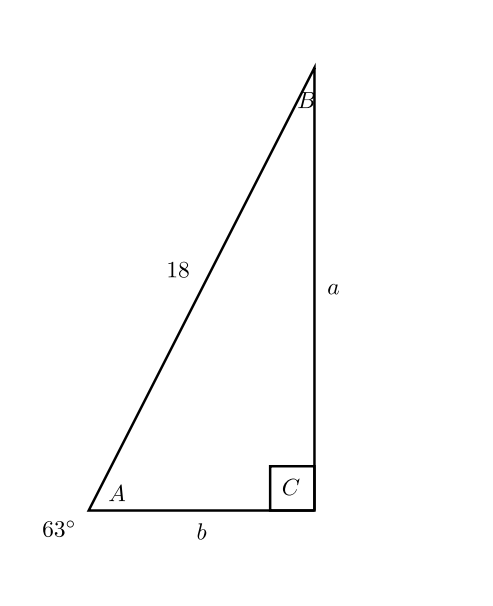
- Identify the Given Information:
- Angle
- Hypotenuse
- Side is opposite to angle .
- Apply the Sine Ratio:
- Solve for :
Practice Problem 3
Express rad in degrees. (Enter exact values.)
Practice Problem 4
Express in radians. (Enter exact values.)
Practice Problem 5
A wooden ramp is to be built with one end on the ground and the other end at the top of a short staircase. If the top of the staircase is from the ground and the angle between the ground and the ramp is to be , how long does the ramp need to be? Round your answer to four decimal places.
- Apply the Sine Ratio:
- Calculate:
Regroup 1
- Review unit circle quadrant signs and reference angles.
- Review radian-degree conversion factors.
Skill Block 2
Worked Example A: Algebraic Limit Evaluation
Evaluate the following limit:
- Check for Indeterminate Form: Substituting gives .
- Factor Numerator and Denominator:
- Numerator:
- Denominator:
- Cancel Common Factor :
- Evaluate by Substitution:
Worked Example B: Piecewise Continuity and Differentiability
Find the values of and that make the following piecewise defined function both continuous and differentiable everywhere:
- Apply Continuity Condition at :
- Apply Differentiability Condition at :
- Solve for :
Worked Example C: Norman Window Optimization
A Norman window is constructed by adjoining a semicircle to the top of a rectangular window. What is the maximum possible area, in square meters, of a Norman window with a perimeter of meters?
- Set Up Perimeter and Area Equations:
Let the rectangle have width and height . The semicircle has radius .
- Perimeter:
- Area:
- Substitute to express in terms of :
- Maximize Area by Taking the Derivative:
- Calculate Maximum Area:
Practice Problem 6: Concept & Reading Check
Open this Skill Block on the Memex to locate the information needed to answer the following:
- (a) Under the Conceptual Framework section, how do we ensure a piecewise function is continuous and differentiable at its boundary?
- (b) Look at Worked Example B. Explain why we set the derivatives of the two pieces equal to each other at to find the value of .
- (c) Trace Worked Example C. How is the perimeter equation used to express the window area in terms of a single variable before maximizing?
- (a) As explained in the Conceptual Framework section, a piecewise function is continuous at a boundary point if the left limit, right limit, and function value are all equal (). It is differentiable if the derivative limits match at the boundary ().
- (b) In Worked Example B, the differentiability condition at the boundary is applied. The derivative of the left piece is , and the derivative of the right piece is . Setting them equal at gives , which immediately isolates .
- (c) Tracing Worked Example C, the window area depends on both (height) and (width). Using the perimeter constraint , we isolate . Substituting this into the area equation yields a single-variable quadratic function in terms of , allowing us to find the maximum using single-variable calculus.
Practice Problem 7
Evaluate:
- Multiply by the Conjugate:
- Cancel Common Factor and Evaluate:
Practice Problem 8
Consider a function with critical points at , , , and . Based on the sign table for below, on which of the intervals is increasing?
| Interval | |||||
|---|---|---|---|---|---|
| Sign of |
Read the table and select the intervals with a positive () derivative sign. All intervals except have , indicating the function is increasing.
Practice Problem 9
The graph of the derivative is given below. On what interval(s) is the function concave up?
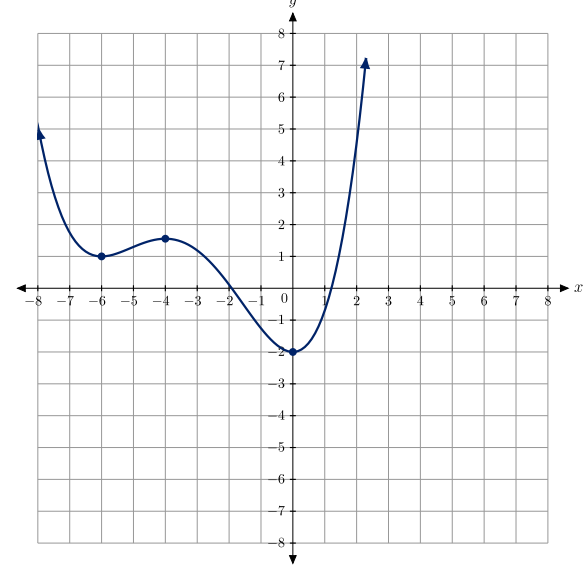
Identify the intervals where the graph of has a positive slope (is rising):
- Rising from to
- Rising from to Thus, the function is concave up on .
Practice Problem 10
Consider the function . Find the -values of all inflection points.
- Find and :
- Solve :
Since changes signs at each of these roots, they are all inflection points.
Practice Problem 11
Consider the function . Over what open interval(s) is the function increasing and concave up?
- Find Increasing Intervals ():
- Find Concave Up Intervals ():
- Find the Intersection: The intersection of and is .
Practice Problem 12
A cell phone plan charges $30 per month for unlimited calls and texts, and each gigabyte (GB) of data is charged at $10 per GB (prorated). If a user uses more than of data, the cost is capped at the cost for . Write a piecewise-defined function for the cost as a function of data in GB.
- For :
- For : Cost is capped at .
Regroup 2
- Review the definition of derivative, concavity, and critical points.
- Discuss standard optimization setup (objective function and constraint).
Skill Block 3
Worked Example A: Geometric Definite Integral (Semicircle)
Evaluate the definite integral using geometric formulas:
- Identify the Curve: The integrand represents a semicircle centered at with radius , sitting above the -axis.
- Check the Bounds: The bounds represent the full domain of the semicircle (from to ).
- Calculate Semicircle Area:
Worked Example B: Net Signed Area
Find the net signed area between the graph of and the -axis over the interval .
- Set Up the Definite Integral:
- Find the Antiderivative:
- Evaluate at the Bounds:
- Upper bound:
- Lower bound:
- Subtract:
Worked Example C: Net Change from a Graph
A function has an initial value . The graph of its derivative is a line passing through with a constant slope of . What is the value of ?
- Apply the Net Change Theorem:
- Calculate the Area under Geometrically:
From to , the graph of forms a right triangle below the -axis.
- Base = 3
- Height = vertical length is 6.
- Area (below -axis) = .
- Solve for :
Practice Problem 13: Concept & Reading Check
Open this Skill Block on the Memex to locate the information needed to answer the following:
- (a) Under the Conceptual Framework section, what is the difference between net signed area and total area when evaluating definite integrals?
- (b) According to the Key Equations & Structural Rules section, how is the accumulated quantity computed from the initial value and the rate of change ?
- (c) Trace Worked Example A. Describe the geometric shape represented by the integrand , including its center and radius.
- (a) As outlined in the Conceptual Framework section, when evaluating an integral, net signed area subtracts regions below the -axis from regions above, whereas total area takes the absolute value of all regions so they are all added positively.
- (b) The Net Change Theorem formula in the Key Equations & Structural Rules section states that the final value equals the initial value plus the net accumulated change, which is the definite integral of the rate function from to .
- (c) Tracing the solution to Worked Example A, the equation of the curve is . Squaring both sides and rearranging yields (with ), which represents a semicircle sitting above the -axis, centered at with a radius of .
Practice Problem 14
Evaluate the definite integral using geometric formulas:
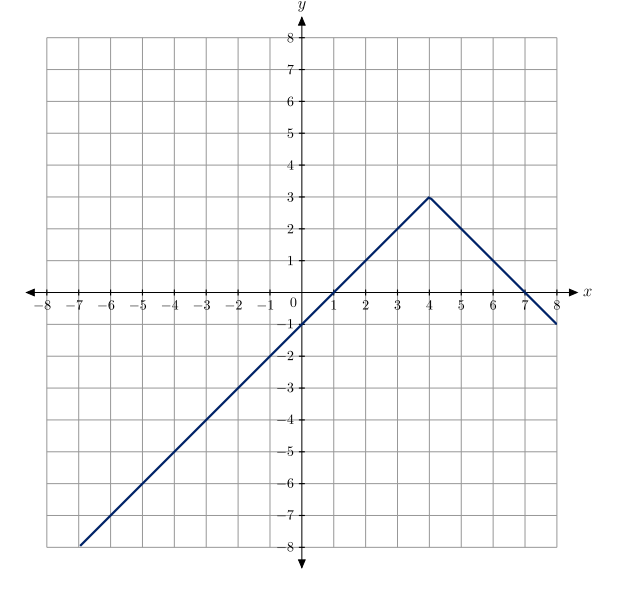
- Find Triangle Dimensions:
- Base: from to .
- Height: peak is at .
- Calculate Area:
Practice Problem 15
The piecewise function is graphed below. Use geometric formulas to find the total area between the graph of the function and the -axis.
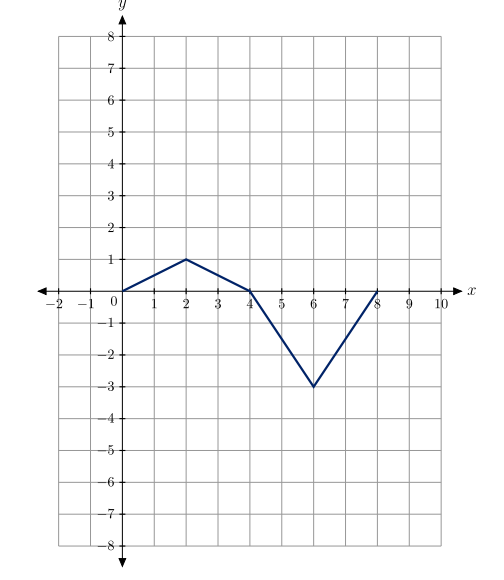
- Calculate Area of Triangle 1 (above axis):
- Base , Height
- Calculate Area of Triangle 2 (below axis):
- Base , Height
- Sum the Areas:
Practice Problem 16
Water leaks out of a tank at a rate of for , measured in gallons per minute. Initially the tank has gallons of water in the tank. How much water is left in the tank after minutes?
- Set Up the Equation:
- Integrate:
- Subtract:
Regroup 3
- Discuss the difference between net signed area and total area.
- Review the Net Change Theorem.
Synthesis Wrap-up
- Re-emphasize key calculus prerequisites.
- Discuss how limits, derivatives, optimization, and integration are generalized to multi-dimensional surfaces in Calculus 3.