Special Limits and Continuity
By the end of this session, you will be able to:
- Evaluate limits of composite functions by analyzing sequential "inside-out" boundary and asymptotic trajectories.
- Compute trigonometric limits using fundamental limit identities and establish bounding inequality envelopes via the Squeeze Theorem.
- Formally verify continuity at a point using the three-part continuity rubric, classify discontinuities (removable, jump, infinite), and determine parameters for continuous piecewise extensions.
📅 Micro-Lecture
1. Composite Function Limits & Inside-Out Trajectories
- Mathematical Foundation: When evaluating a composite function limit limx→cf(g(x)), if limx→cg(x)=L and the outer function f(u) is continuous at u=L, the limit operator passes inside: limx→cf(g(x))=f(L) (see Limits of Composite Functions). When g(x) approaches an infinite asymptote (±∞) or a one-sided boundary, the limit must be tracked sequentially as an intermediate state u→±∞ or u→L±.
- Engineering Context: Cascaded system filters, such as audio pre-amplifier limiter circuits and biomedical insulin infusion pumps, route dynamic signals through multiple nonlinear stages where tracking intermediate asymptotic saturation limits is essential to prevent hardware blowout or medical overdose.
2. Special Trigonometric Limits & Squeeze Theorem
- Mathematical Foundation: Ratios of trigonometric functions near zero frequently produce 00 indeterminate forms. We resolve these using the fundamental geometric identities limθ→0θsin(θ)=1 and limθ→0θ1−cos(θ)=0 (see Special Trigonometric Limits). When functions oscillate with unbounded frequency, the Squeeze Theorem bounds the oscillation between two solvable algebraic curves using inequality envelopes (−g(x)≤f(x)≤g(x)).
- Engineering Context: Laser scanning telemetry apertures in stage tracking systems rely on small-angle trigonometric limits to extract peak beam intensity, while structural civil engineers use squeeze damping envelopes to prove high-rise mass dampers stabilize smoothly without violent impulse shock.
3. Formal Continuity Verification & Discontinuity Taxonomy
- Mathematical Foundation: A function f(x) is continuous at x=c if and only if (1) f(c) is defined, (2) limx→cf(x) exists, and (3) limx→cf(x)=f(c) (see Continuity). Failing any condition produces a classified discontinuity: a removable discontinuity (hole), a jump discontinuity (step), or an infinite discontinuity (vertical asymptote).
- Engineering Context: Microcontroller smart grid power switches and aerospace cryogenic fuel line insulation undergo physical state transitions that are modeled as piecewise boundary functions. Enforcing continuity prevents catastrophic system faults like power surges or brittle pipe fracturing.
Skill Block 1
Real-Life Engineering Applications
Amplifier Hard Limiting (Electrical & Audio Engineering)
In live sound and broadcast engineering, a high-gain audio pre-amplifier circuit boosts an incoming microphone input voltage v (in Volts). To prevent power amplifier overload and speaker cone burnout during acoustic feedback spikes, the amplified signal passes through a multi-stage non-linear compression and hard-limiting saturation circuit.
The total output voltage Vout(v) as a function of the input surge voltage v is modeled by the composite function:
As a sudden electrostatic discharge or feedback loop causes the microphone input voltage to surge toward infinity (v→∞):
- Use the multi-stage inside-out composite limit technique to evaluate limv→∞Vout(v).
- Determine whether the output signal clamps at a finite voltage threshold, and state the maximum output voltage delivered to downstream audio speakers.
💡 Show Worked Derivation
Problem Overview
We are asked to evaluate the asymptotic steady-state limit of the composite output voltage function:
Step-by-Step Mathematical Solution
Step 1: Evaluate the innermost exponential boundary layer
Consider the innermost expression g(v)=1+ev. As v→∞, the exponential term grows without bound:
Step 2: Evaluate the intermediate natural logarithm layer
Let u=1+ev. Since u→∞, evaluate the limit of the natural logarithm as its argument grows infinitely large:
Step 3: Evaluate the outer inverse tangent saturation layer
Let w=ln(u)=ln(1+ev). Since w→∞, evaluate the outer scaled arctangent function:
Recall the horizontal asymptote of the inverse tangent function: limw→∞tan−1(w)=2π. Multiplying by the amplitude scale factor 5:
Engineering Conclusion
As the raw microphone input voltage surges infinitely high (v→∞), the composite limiting circuit safely saturates and clamps the output signal at exactly 25π V≈7.85 V. This verified mathematical upper bound guarantees that downstream power amplifiers and loudspeaker components will not experience catastrophic electrical burnout.
Automated Insulin Delivery Infusion (Biomedical Engineering)
In closed-loop biomedical devices, an automated artificial pancreas regulates blood glucose levels by computing active residual insulin in the patient's bloodstream before authorizing a micro-bolus injection.
The residual active insulin I(t) (in Units) over elapsed time t (in hours) since the last automated basal release valve activation is modeled by the composite saturation decay function:
- Using composite limit techniques, evaluate limt→0+I(t) to determine the instantaneous active insulin baseline at the exact instant the infusion valve opens.
- If the control algorithm required a non-zero initial reference value of 10 Units to prevent a double-dose calculation error, verify whether the system meets this physiological baseline specification.
💡 Show Worked Derivation
Problem Overview
We evaluate the right-sided limit of the residual insulin concentration function:
Step-by-Step Mathematical Solution
Step 1: Evaluate the innermost exponent fraction
Look at the nested rational term u(t)=−t21 as t→0+: As t approaches 0 through positive values, t2 approaches 0 through positive values (t2→0+). Therefore:
Step 2: Evaluate the exponential intermediate layer
Let u=−t21. As u→−∞, evaluate the natural exponential decay:
Step 3: Evaluate the overall rational composite expression
Substitute the evaluated exponential limit (0) back into the denominator of the full expression:
Engineering Conclusion
The composite limit cleanly evaluates to limt→0+I(t)=10 Units. This confirms that the infusion algorithm reliably initializes at the full basal dosage of 10 Units at the moment of valve opening (t→0+), eliminating mathematical numerical instabilities and preventing a fatal insulin overdose.
Evaluating Composite Function Limits ("Inside-Out" Evaluation)
General Overview
Skill Block 1 focuses on evaluating limits of nested functions f(g(x)) by decomposing multi-stage operations, tracking directional intermediate outputs, and analyzing asymptotic end-behavior.
Conceptual Framework
- Sequential Multi-Stage Pipeline: Analyze the limit of the inner function u=g(x) first. Then pass that resulting value or directional infinity (±∞) into the outer function f(u) as its effective input.
- The Outer Continuity Condition: The identity limx→cf(g(x))=f(limx→cg(x)) is valid when the outer function f is continuous at the inner limit value.
- Directional & Asymptotic Inner Outputs: If g(x)→−∞, g(x)→+∞, or approaches a value from one side (u→0+), the outer function must be evaluated with respect to that specific asymptotic boundary.
- Dominance in Composite Fractions: For composite exponential or rational quotients, factor out the fastest-growing dominant term to resolve indeterminate forms at infinity.
Key Equations & Structural Rules
- Composition Limit Rule: If limx→cg(x)=L and f is continuous at L, then limx→cf(g(x))=f(L) (see Limits of Composite Functions).
- Arctangent Asymptotes: limu→∞tan−1(u)=2π and limu→−∞tan−1(u)=−2π.
- Natural Logarithm Boundary: limx→0+ln(x)=−∞.
- Exponential Decay Boundary: limt→−∞et=0.
Worked Example A: Inside-Out Evaluation with Asymptotic Boundaries
Evaluate the limit:
💡 Reveal Worked Solution
- Isolate and evaluate the inner limit: Identify the inner function g(x)=lnx. As x approaches 0 from the right (x→0+), the natural logarithm drops without bound towards negative infinity:
x→0+limlnx=−∞
- Pass the intermediate result to the outer function: Let u=lnx. Since u→−∞, rewrite the problem in terms of the outer inverse tangent function f(u)=tan−1(u):
u→−∞limtan−1(u)
- Evaluate the outer boundary limit: Recall the horizontal asymptote of the inverse tangent curve as its input tends toward negative infinity:
u→−∞limtan−1(u)=−2π
- Final Conclusion:
x→0+limtan−1(lnx)=−2π
Worked Example B: Composite Directional Exponential Limit
Evaluate the limit:
💡 Reveal Worked Solution
- Analyze the inner exponent: Let t=x1. As x approaches 0 from the negative side (x→0−), the reciprocal fraction becomes infinitely negative:
x→0−limx1=−∞
- Evaluate the outer exponential function: Substitute the intermediate behavior t→−∞ into the outer function f(t)=et:
t→−∞limet=0
- Final Conclusion:
x→0−lime1/x=0
Practice Problem 1: Concept & Reading Check
Open this Skill Block on the Memex to locate the information needed to answer the following:
- (a) Under the Conceptual Framework section, under what condition can the limit operator be moved directly inside an outer function (limf(g(x))=f(limg(x)))?
- (b) In Worked Example A, explain why the intermediate variable u=lnx approaches −∞ and how that leads to the final value of −2π.
- (c) Review the linked Engineering Applications ("Audio Pre-Amplifier Hard Limiting"). Why is evaluating limv→∞Vout(v) critical for audio and electrical engineers designing saturation circuits?
Check the Conceptual Framework regarding outer function continuity, review steps 1–3 of Worked Example A, and refer to the linked Engineering Application <a class="text-accent underline font-semibold" href="/garden/audio-pre-amplifier-hard-limiting--electrical---audio-engineering-">Audio Pre-Amplifier Hard Limiting (Electrical & Audio Engineering)</a>.
Answer: * (a) The limit operator can be moved directly inside if the inner limit exists (limg(x)=L) and the outer function f is continuous at L.
- (b) Because limx→0+lnx=−∞, the outer function becomes limu→−∞tan−1(u)=−2π due to the horizontal asymptote of arctangent.
- (c) It guarantees that when input voltage spikes infinitely high, the output voltage saturates at a finite clamping threshold (25π V), preventing amplifier overload and speaker damage.
Step-by-Step Execution
- (a) As stated in the Conceptual Framework, the composition rule limx→cf(g(x))=f(limx→cg(x))=f(L) is valid if and only if limx→cg(x)=L is a finite real number and the outer function f(u) is continuous at u=L. If g(x)→±∞, the limit must be evaluated as an asymptotic limit of the outer function.
- (b) In Worked Example A, the inner function g(x)=lnx approaches −∞ as x→0+ because the natural logarithm has a vertical asymptote at x=0 dropping towards −∞. Substituting u=lnx→−∞ into tan−1(u) evaluates to the lower horizontal asymptote y=−2π.
- (c) In
<a class="text-accent underline font-semibold" href="/garden/audio-pre-amplifier-hard-limiting--electrical---audio-engineering-">Audio Pre-Amplifier Hard Limiting (Electrical & Audio Engineering)</a>, evaluating limv→∞5tan−1(ln(1+ev)) verifies that the output signal saturates at a finite maximum voltage of 25π V≈7.85 V, confirming that hardware limiters prevent downstream speaker blowout.
Practice Problem 2
Evaluate the limit using algebraic dominance and composite limit techniques:
As x→∞, ex→∞, producing the indeterminate form −∞∞. Divide every term in the numerator and denominator by the dominant exponential term ex.
Answer:
Step-by-Step Execution
- Identify Indeterminate Form: Direct substitution of x→∞ yields −∞∞.
- Divide by the Dominant Term: Divide numerator and denominator by ex:
x→∞limex1−exexex1+exex=x→∞lime−x−1e−x+1
- Evaluate Limits of Component Fractions: Since limx→∞e−x=limx→∞ex1=0:
0−10+1=−11=−1
Practice Problem 3
Evaluate the composite limit:
Simplify the rational expression inside the logarithm by factoring the numerator (x−1)(x+1) before applying the continuous logarithm function.
Answer:
Step-by-Step Execution
- Factor and cancel the inner rational expression:
x→1+limx−1x2−1=x→1+limx−1(x−1)(x+1)=x→1+lim(x+1)=1+1=2
- Apply the continuous logarithm function:
Since the natural logarithm is continuous at u=2:
x→1+limln(x−1x2−1)=ln(x→1+limx−1x2−1)=ln(2)
Practice Problem 4
Evaluate the composite limit:
Evaluate the exponent −x1 as x→0+, then evaluate the exponential layer eu, and finally substitute into the continuous cosine function.
Answer:
Step-by-Step Execution
- Analyze the inner exponent: As x→0+:
x→0+lim(−x1)=−∞
- Evaluate the exponential layer: Pass this intermediate state into eu:
u→−∞limeu=0
- Evaluate the outer trigonometric function: Pass 0 into the continuous outer cosine function:
cos(0)=1Therefore:x→0+limcos(e−1/x)=1
📅 Regroup 1
- When tracking composite limits, always write down the substitution variable u=g(x) and its directional target explicitly to avoid sign errors with vertical asymptotes.
- Remember that limf(g(x))=f(limg(x)) applies only when the outer function is continuous at that point; infinite inner limits require analyzing the outer function's end behavior.
Skill Block 2
Real-Life Engineering Applications
Earthquake Damping Envelope (Civil & Structural Engineering)
During high-rise building design in seismically active regions, structural engineers install tuned mass dampers (TMDs) at the roof level to absorb vibrational energy during earthquakes.
Upon the sudden arrival of an impulsive shear wave at time t=0 seconds, the initial transient lateral displacement x(t) (in centimeters) of the damper assembly for t>0 is governed by the high-frequency oscillatory response:
- Set up a bounding sandwich inequality using the fundamental range of the sine function.
- Apply the Squeeze Theorem to evaluate limt→0+x(t).
- Explain the civil engineering significance of this limit for the structural safety of the building's joints at the instant of shock impact.
💡 Show Worked Derivation
Problem Overview
We are asked to evaluate the initial transient displacement limit of the tuned mass damper:
Step-by-Step Mathematical Solution
Step 1: Establish the trigonometric range bounds
For any non-zero time t>0, the argument t50 produces rapid oscillation, but the output of the sine function remains strictly bounded between −1 and 1:
Step 2: Multiply by the quadratic damping envelope t2
Because t>0, t2 is strictly positive (t2>0). Multiplying all three parts of the inequality by t2 preserves the inequality signs (see Solving Inequalities):
Step 3: Evaluate the limits of the lower and upper bounding envelopes
Compute the limits of the outer boundary functions as t→0+:
Step 4: Apply the Squeeze Theorem
Because −t2≤x(t)≤t2 and both bounding parabolas pinch together to 0 as t→0+, by the Squeeze Theorem:
Engineering Conclusion
Even though the damper experiences extreme vibrational frequency as t→0+, the quadratic envelope t2 successfully dampens the amplitude to zero. This mathematical proof verifies that the damper starts from a state of zero displacement without undergoing discontinuous initial impulse jumps that would snap mounting brackets or fracture high-rise structural anchor bolts.
Angle Approximation (Entertainment & Computer Engineering)
In automated live entertainment stage rigging and motion capture tracking, a laser scanner tracks performers across the stage using high-speed optical galvo mirrors.
When the scanning laser passes through an optical diffraction aperture, the measured light intensity I(θ) (in Watts/m2) detected by the photodiode sensor array as a function of the deflection angle θ (in radians) is given by:
- Attempt direct substitution of θ=0 into I(θ) and explain why this creates an indeterminate form for the optical sensor micro-controller.
- Apply the special trigonometric limit identity limu→0usin(u)=1 to calculate the exact peak centerline intensity limθ→0I(θ).
- State the calibrated intensity value the embedded software should assign to the central on-axis point θ=0 to prevent computational division-by-zero crashes.
💡 Show Worked Derivation
Problem Overview
We evaluate the central optical intensity limit:
Step-by-Step Mathematical Solution
Step 1: Diagnose the indeterminate form
Direct substitution of θ=0 yields:
Step 2: Separate constants and match the trigonometric argument
Factor the constant scalar 21 out of the denominator and balance the argument 4θ:
Step 3: Apply the fundamental trigonometric limit identity
Let u=4θ. As θ→0, u→0. Recall the fundamental limit:
Therefore:
Engineering Conclusion
The exact physical peak intensity along the central optic axis (θ→0) is 2 W/m2. In the embedded firmware, the computer engineer should program a continuous removable patch:
Special Trigonometric Limits & The Squeeze Theorem
General Overview
Skill Block 2 introduces the fundamental geometric trigonometric limits and the Squeeze (Sandwich) Theorem for evaluating bounded oscillating functions.
Conceptual Framework
- The Trigonometric Indeterminate Form: Ratios of xsinx produce 00 at x=0. Geometric unit-circle sector bounds prove that θsinθ→1 as θ→0.
- Argument Scaling & Balancing: To apply limθ→0θsinθ=1, the algebraic argument of the sine function must match the denominator exactly.
- The Squeeze Theorem Principle: If g(x)≤f(x)≤h(x) on an open interval containing c, and limx→cg(x)=limx→ch(x)=L, then the middle function is trapped and must satisfy limx→cf(x)=L (see Squeeze Theorem and Solving Inequalities).
- Oscillation Damping: High-frequency terms like sin(1/x) or cos(1/x) fluctuate infinitely between −1 and 1, but multiplying by an envelope factor x2 or ∣x∣ squeezes the overall amplitude to 0.
Key Equations & Structural Rules
- Fundamental Sine Limit: limθ→0θsin(θ)=1 and limθ→0sin(θ)θ=1 (see Special Trigonometric Limits).
- Fundamental Cosine Limit: limθ→0θ1−cos(θ)=0.
- Trigonometric Argument Ratio: limx→0bxsin(ax)=ba and limx→0bxtan(ax)=ba.
- Trigonometric Range Bound: −1≤sin(u)≤1 and −1≤cos(u)≤1 for all real arguments u.
Worked Example A: The Squeeze Theorem with Given Function Bounds
Given there exists a function h(x) such that 2x3+8≤h(x)≤x4+8 for all x near 2, find limx→23h(x)+5.
💡 Reveal Worked Solution
- Evaluate the limits of the lower and upper bounding functions:
- Lower bound limit: limx→2(2x3+8)=2(23)+8=2(8)+8=24
- Upper bound limit: limx→2(x4+8)=24+8=16+8=24
- Apply the Squeeze Theorem to isolate limx→2h(x):
Since 2x3+8≤h(x)≤x4+8 and both bounding limits equal 24, by the Squeeze Theorem:
x→2limh(x)=24
- Evaluate the target expression using Limit Laws:
x→2lim3h(x)+5=3(limx→2h(x))+5=324+5=329
Worked Example B: Squeeze Theorem on Bounded Oscillations
Evaluate the limit:
💡 Reveal Worked Solution
- Establish the fundamental trigonometric bounds:
For all x=0, the range of the sine function is bounded between −1 and 1:
−1≤sin(x1)≤1
- Construct the sandwich inequality:
Since x2>0 for all x=0, multiply all three parts of the inequality by x2 (preserving inequality direction):
−x2≤x2sin(x1)≤x2
- Evaluate the bounding limits:
x→0lim(−x2)=0andx→0lim(x2)=0
- Apply the Squeeze Theorem:
Because the lower and upper bounding parabolas converge to 0, the trapped middle function must also converge to 0:
x→0limx2sin(x1)=0
Worked Example C: Special Trigonometric Limit with Coefficient Scaling
Evaluate the limit:
💡 Reveal Worked Solution
- Factor out constants and separate independent limits:
x→0lim(32⋅cos(x)⋅xsin(4x))=32⋅(x→0limcos(x))⋅(x→0limxsin(4x))
- Scale the argument of the sine limit:
Multiply the numerator and denominator of the sine term by 4:
x→0limxsin(4x)=4⋅x→0lim4xsin(4x)=4(1)=4
- Combine evaluated components:
Since limx→0cos(x)=cos(0)=1:
32⋅(1)⋅(4)=38
Practice Problem 5: Concept & Reading Check
Open this Skill Block on the Memex to locate the information needed to answer the following:
- (a) Under the Conceptual Framework section, what are the two fundamental trigonometric limit identities? What indeterminate form do they resolve?
- (b) In Worked Example B, why is it valid to multiply the inequality −1≤sin(1/x)≤1 by x2 without flipping the inequality signs?
- (c) Review the linked Engineering Applications ("Earthquake Damping Envelope"). How do civil engineers use the Squeeze Theorem to verify that a building's mass damper starts with zero displacement at t→0+?
Check the Key Equations for trig limits, review the inequality multiplier rule in step 2 of Worked Example B, and refer to the linked Engineering Application <a class="text-accent underline font-semibold" href="/garden/earthquake-damping-envelope--civil---structural-engineering-">Earthquake Damping Envelope (Civil & Structural Engineering)</a>.
Answer: * (a) limθ→0θsinθ=1 and limθ→0θ1−cosθ=0. They resolve the 00 indeterminate form.
- (b) Because x2>0 for all x=0, multiplying by a strictly positive quantity preserves the direction of inequalities.
- (c) Bounding lateral sway x(t)=t2sin(50/t) between ±t2 proves that as t→0+, displacement converges to 0 cm without discontinuous impulse snapping.
Step-by-Step Execution
- (a) As stated in the Conceptual Framework and Key Equations, the two identities are limθ→0θsin(θ)=1 and limθ→0θ1−cos(θ)=0. Both resolve the 00 indeterminate form that occurs when substituting θ=0.
- (b) In Worked Example B, x2 is strictly positive for all non-zero real numbers (x2>0 for all x=0). According to the rules of Solving Inequalities, multiplying an inequality by a positive number preserves the order of all terms without reversing the inequality signs.
- (c) In
<a class="text-accent underline font-semibold" href="/garden/earthquake-damping-envelope--civil---structural-engineering-">Earthquake Damping Envelope (Civil & Structural Engineering)</a>, the initial transient sway of the roof damper is modeled by x(t)=t2sin(50/t). Sandwiched between −t2 and +t2, the Squeeze Theorem proves limt→0+x(t)=0 cm, verifying that the damper starts from rest and will not experience shock fractures during seismic onset.
Practice Problem 6
Evaluate the following trigonometric limit:
Factor out the constant 21 from the denominator and multiply the numerator and denominator by 5 to form 5xsin(5x).
Answer:
Step-by-Step Execution
- Factor out constant coefficients:
x→0lim2xsin(5x)=21x→0limxsin(5x)
- Match the argument:
Multiply and divide by 5:
21⋅5⋅x→0lim5xsin(5x)=25⋅u→0limusin(u)
- Apply the fundamental limit:
25⋅(1)=25
Practice Problem 7
Evaluate the trigonometric limit:
Rewrite tan(3x)=cos(3x)sin(3x), then split into 3xsin(3x)⋅sin(7x)7x⋅73⋅cos(3x)1.
Answer:
Step-by-Step Execution
- Express tangent in terms of sine and cosine:
sin(7x)tan(3x)=cos(3x)sin(7x)sin(3x)=sin(7x)sin(3x)⋅cos(3x)1
- Multiply and divide by 3x and 7x:
x→0lim(7xsin(7x)⋅7x3xsin(3x)⋅3x⋅cos(3x)1)=x→0lim(7xsin(7x)3xsin(3x)⋅73⋅cos(3x)1)
- Substitute known limits:
Since limx→0kxsin(kx)=1 and limx→0cos(3x)=1:
x→0limsin(7x)tan(3x)=11⋅73⋅11=73
Practice Problem 8
Evaluate the limit using the Squeeze Theorem:
Bound −1≤cos(π/x)≤1, multiply by ∣x∣≥0, and evaluate limx→0(±∣x∣).
Answer:
Step-by-Step Execution
- Bound the cosine function:
−1≤cos(xπ)≤1for all x=0
- Construct the inequality:
Since ∣x∣>0 for all x=0, multiply through by ∣x∣:
−∣x∣≤∣x∣cos(xπ)≤∣x∣
- Evaluate the bounding limits:
Since limx→0(−∣x∣)=0 and limx→0∣x∣=0, by the Squeeze Theorem:
x→0lim∣x∣cos(xπ)=0
📅 Regroup 2
- Always verify that the trigonometric argument matches the denominator before replacing usin(u) with 1.
- To use the Squeeze Theorem, you must explicitly write down both the bounding inequality AND show that both outer limits converge to the exact same numerical value.
Skill Block 3
Real-Life Engineering Applications
Cryogenic Aerospace Polymer Phase Transition (Materials & Aerospace Engineering)
In launch vehicle propellant design, liquid oxygen (LOX) cryogenic fuel lines are wrapped in high-performance polymer insulation to prevent thermal boil-off.
At low temperatures near liquid nitrogen levels (T=77 Kelvin), the polymer undergoes a glass-transition phase change where its mechanical flexibility changes abruptly. The effective thermal conductivity k(T) (in W/(m⋅K)) as a function of temperature T (in Kelvin) is modeled by the piecewise function:
- Apply the three-part continuity rubric to test whether the thermal conductivity function k(T) is continuous at the phase transition point T=77 K.
- If k(T) is discontinuous at T=77 K, classify the type of discontinuity (Removable, Jump, or Infinite) and compute the jump magnitude Δk.
- Discuss the aerospace engineering implications of this discontinuity on the thermodynamic stress across the rocket fuel line.
💡 Show Worked Derivation
Problem Overview
We evaluate the continuity of the thermal conductivity function k(T) at the glass transition threshold T=77 K:
Step-by-Step Mathematical Solution
Step 1: Condition 1 — Check k(77)
From the explicit point specification in the piecewise definition:
Step 2: Condition 2 — Check limT→77k(T)
Evaluate the left-hand and right-hand limits as T approaches 77:
- Left-hand limit (T→77−):
T→77−lim(0.02T+0.5)=0.02(77)+0.5=1.54+0.5=2.04 W/(m⋅K)
- Right-hand limit (T→77+):
T→77+lim(0.0003T2+0.3)=0.0003(772)+0.3=0.0003(5929)+0.3=1.7787+0.3=2.0787 W/(m⋅K)
Compare the one-sided limits:
Step 3: Classify the discontinuity
Both one-sided limits exist as finite real numbers (2.04 and 2.0787), but they are unequal.
- Classification: Jump Discontinuity
- Jump Magnitude: Δk=∣2.0787−2.04∣=0.0387 W/(m⋅K).
Engineering Conclusion
Because the thermal conductivity exhibits a jump discontinuity of 0.0387 W/(m⋅K) at 77 K, heat flux through the insulation changes discontinuously. In aerospace rocket engineering, this sudden change induces localized thermal stress gradients across the fuel line wall during cryogenic fueling, requiring engineers to install flexible expansion bellows to prevent brittle insulation spalling and tank wall rupture.
Smart Grid Dynamic Power Clamping (Computer & Electrical Engineering)
In smart power distribution grid substations, an embedded microcontroller manages dynamic power routing P(I) (in Kilowatts) across a transformer busbar as a function of incoming line current I (in Amperes).
To prevent arithmetic division-by-zero faults during sensor polling while ensuring power flow remains seamless across a calibration point at I=4 A, the power management firmware defines the piecewise transfer function:
- Evaluate the limit of the unpatched power expression as current approaches the threshold: limI→4I−4I2−16.
- Using the three-part continuity rubric, determine the exact parameter value k required to make P(I) continuous for all current levels I.
- Explain how setting this exact k value prevents electrical relay tripping in the smart grid substation.
💡 Show Worked Derivation
Problem Overview
We evaluate the continuity parameter k for the dynamic power transfer function:
Step-by-Step Mathematical Solution
Step 1: Evaluate the limit as I→4
Direct substitution of I=4 into the open rational branch yields 4−442−16=00 (indeterminate form).
Resolve the indeterminate form by factoring the difference of squares in the numerator (see Factor and Cancel):
For all I=4, cancel the shared zero factor (I−4):
Step 2: Evaluate the defined function value at I=4
From the point definition branch at I=4:
Step 3: Enforce Condition 3 of the Continuity Rubric
For P(I) to be continuous at I=4, the approached limit must equal the assigned point value:
Engineering Conclusion
Setting the microcontroller gain parameter to k=2.5 forces the assigned power value P(4)=4(2.5)−2=8 kW to match the limiting power trajectory exactly. This eliminates the removable discontinuity (hole) at I=4 A, ensuring smooth, uninterrupted power delivery and preventing false-positive circuit breaker trips caused by computational glitches.
Continuity Verification, Classification, and Piecewise Parameters
General Overview
Skill Block 3 provides the rigorous three-part rubric for proving continuity at a point, classifying discontinuities into removable, jump, and infinite types, and solving for algebraic parameters to force continuous connections across piecewise boundaries.
Conceptual Framework
- The Three-Part Continuity Rubric: A function f(x) is continuous at x=c if and only if:
- f(c) is defined (in the domain).
- limx→cf(x) exists (limx→c−f(x)=limx→c+f(x)=L).
- limx→cf(x)=f(c).
- Discontinuity Classification Taxonomy:
- Removable Discontinuity (Hole): limx→cf(x)=L exists, but f(c) is undefined or f(c)=L.
- Jump Discontinuity (Step): Both one-sided limits exist as finite values, but limx→c−f(x)=limx→c+f(x).
- Infinite Discontinuity (Vertical Asymptote): One or both one-sided limits blow up to ±∞.
- Piecewise Boundary Stitching: To make a piecewise function continuous across a boundary x=c, set the left-hand limit, right-hand limit, and defined point value equal to each other and solve the resulting algebraic system for the unknown parameter constants (such as k, a, or b).
Key Equations & Structural Rules
- Continuity Condition: limx→cf(x)=f(c) (see Continuity).
- Intermediate Value Theorem (IVT): If f is continuous on [a,b] and u is strictly between f(a) and f(b), there exists at least one c∈(a,b) such that f(c)=u (see Intermediate Value Theorem).
- Two-Sided Limit Agreement: limx→c−f(x)=limx→c+f(x)=L (see Existence Theorem for Two-Sided Limits).
- Jump Magnitude Formula: Δy=∣limx→c+f(x)−limx→c−f(x)∣ (see Jump Discontinuity).
Worked Example A: Testing Continuity and Classifying Discontinuities
Using the conditions of continuity, determine if f(x) is continuous at x=2 and x=4. If discontinuous, state the type:
💡 Reveal Worked Solution
- Test Continuity at x=2:
- Condition 1 — f(2) defined: From the point definition, f(2)=5 (Defined).
- Condition 2 — limx→2f(x) exists:
- Left limit: limx→2−(3x−1)=3(2)−1=5
- Right limit: limx→2+(x2+1)=22+1=5
- Since both one-sided limits equal 5, limx→2f(x)=5 (Exists).
- Condition 3 — Agreement: limx→2f(x)=f(2)=5.
- Conclusion at x=2: f(x) is continuous at x=2.
- Test Continuity at x=4:
- Condition 1 — f(4) defined: Using the x≤4 branch, f(4)=42+1=17 (Defined).
- Condition 2 — limx→4f(x) exists:
- Left limit: limx→4−(x2+1)=42+1=17
- Right limit: limx→4+x−48=0+8=+∞
- Since the right-hand limit diverges to infinity, the two-sided limit does not exist (DNE).
- Conclusion at x=4: f(x) is discontinuous at x=4 with an infinite discontinuity (vertical asymptote at x=4).
Worked Example B: Solving for a Parameter to Ensure Global Continuity
Find the value of k for which g(x) is continuous everywhere:
💡 Reveal Worked Solution
- Find the defined function value at x=3:
Using the point rule for x=3:
g(3)=k(3)=3k
- Evaluate the limit as x→3:
Direct substitution into the open rational branch yields 00. Deflate the indeterminate form by factoring the difference of squares:
x→3limx−3x2−9=x→3limx−3(x−3)(x+3)=x→3lim(x+3)=3+3=6
- Enforce Condition 3 of the Continuity Rubric:
For g(x) to be continuous, we require limx→3g(x)=g(3):
6=3k⟹k=36=2
- Final Conclusion: Setting k=2 removes the hole at x=3 and makes g(x) continuous everywhere.
Practice Problem 9: Concept & Reading Check
Open this Skill Block on the Memex to locate the information needed to answer the following:
- (a) Under the Conceptual Framework section, state the three conditions required for a function f(x) to be continuous at x=c.
- (b) In Worked Example A, why did f(x) pass the continuity test at x=2 but fail at x=4?
- (c) Review the linked Engineering Applications ("Cryogenic Aerospace Polymer Phase Transition"). Why does a jump discontinuity in thermal conductivity create thermal stress in rocket fuel lines?
Check the Three-Part Continuity Rubric, compare the limit evaluations at x=2 and x=4 in Worked Example A, and refer to the linked Engineering Application <a class="text-accent underline font-semibold" href="/garden/cryogenic-aerospace-polymer-phase-transition--materials---aerospace-engineering-">Cryogenic Aerospace Polymer Phase Transition (Materials & Aerospace Engineering)</a>.
Answer: * (a) (1) f(c) is defined, (2) limx→cf(x) exists, and (3) limx→cf(x)=f(c).
- (b) At x=2, all three conditions were met (5=5=5). At x=4, the right-hand limit exploded to +∞, failing Condition 2.
- (c) A jump discontinuity causes a discontinuous shift in heat flux, inducing abrupt temperature gradients that create thermal expansion stress and threaten brittle fracture.
Step-by-Step Execution
- (a) As stated in the Conceptual Framework, a function f(x) is continuous at x=c if and only if: (1) f(c) is defined (yielding a real number), (2) limx→cf(x) exists (meaning limx→c−f(x)=limx→c+f(x)=L), and (3) limx→cf(x)=f(c).
- (b) In Worked Example A, at x=2, f(2)=5, limx→2f(x)=5, and both match, satisfying all 3 conditions. At x=4, while f(4)=17 and the left limit is 17, the right-hand limit is limx→4+x−48=+∞, so the two-sided limit does not exist, violating Condition 2.
- (c) In
<a class="text-accent underline font-semibold" href="/garden/cryogenic-aerospace-polymer-phase-transition--materials---aerospace-engineering-">Cryogenic Aerospace Polymer Phase Transition (Materials & Aerospace Engineering)</a>, the thermal conductivity k(T) jumps discontinuously by 0.0387 W/(m⋅K) across the 77 K cryogenic boundary. This discontinuous conductivity creates abrupt localized thermal gradients, producing thermal stress that can crack brittle insulation or rupture propellant lines.
Practice Problem 10
Using the conditions of continuity, determine if f(x) is continuous at x=0 and x=1. If f(x) is discontinuous at either point, indicate the type of discontinuity:
Evaluate f(0), limx→0−f(x), and limx→0+f(x) for the x=0 boundary. Then evaluate f(1), limx→1−f(x), and limx→1+f(x) for the x=1 boundary.
Answer: * At x=0: Continuous
- At x=1: Discontinuous (Jump Discontinuity)
Step-by-Step Execution
- Testing Continuity at x=0:
- f(0)=e0=1 (Condition 1 satisfied).
- Left limit: limx→0−(1−x)=1−0=1.
- Right limit: limx→0+ex=e0=1.
- Since left and right limits match, limx→0f(x)=1 (Condition 2 satisfied).
- limx→0f(x)=f(0)=1 (Condition 3 satisfied).
- Conclusion at x=0: Continuous.
- Testing Continuity at x=1:
- f(1)=e1=e≈2.718 (Condition 1 satisfied).
- Left limit: limx→1−ex=e1=e.
- Right limit: limx→1+(x2+2)=12+2=3.
- Since limx→1−f(x)=e=3=limx→1+f(x), the overall limit does not exist (Condition 2 fails).
- Conclusion at x=1: Discontinuous with a jump discontinuity (Δy=3−e≈0.282).
Practice Problem 11
Find the values of constants a and b such that the function f(x) is continuous for all real numbers:
For f(x) to be continuous at x=2, both the left-hand limit limx→2−(ax+3) and the right-hand limit limx→2+(bx2−1) must equal the defined function value f(2)=5.
Answer:
Step-by-Step Execution
- Set the left-hand limit equal to f(2):
x→2−limf(x)=x→2−lim(ax+3)=2a+3Equate to f(2)=5:2a+3=5⟹2a=2⟹a=1
- Set the right-hand limit equal to f(2):
x→2+limf(x)=x→2+lim(bx2−1)=b(22)−1=4b−1Equate to f(2)=5:4b−1=5⟹4b=6⟹b=46=23
- Conclusion: The function is continuous everywhere when a=1 and b=23.
Practice Problem 12
Consider a function f(x) that satisfies all of the following specifications:
- f(x) is continuous for all x except x=−2, x=0, and x=3.
- f(0) is undefined.
- limx→0f(x)=3.
- limx→−2−f(x)=−∞ and limx→−2+f(x)=∞.
- limx→3−f(x)=∞ and limx→3+f(x)=−∞.
- limx→−∞f(x)=5 and limx→∞f(x)=5.
(a) State the equation(s) for any horizontal asymptote(s) of f(x).
(b) State the equation(s) for any vertical asymptote(s) of f(x).
(c) Identify all x-values where f(x) has discontinuities and classify each by type.
(d) Sketch a possible graph of f(x) on the coordinate grid below.
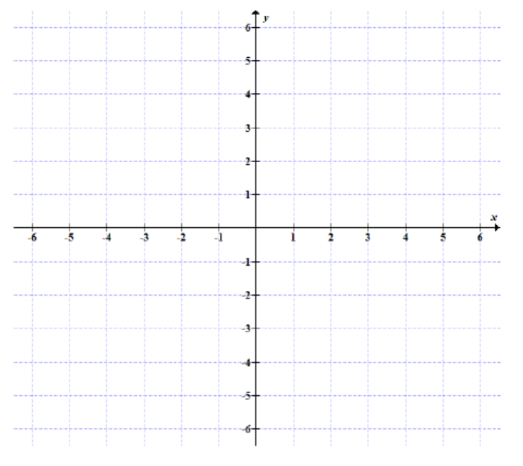
- Horizontal asymptotes come from the limits at ±∞.
- Vertical asymptotes come from finite x-values where one-sided limits approach ±∞.
- Classify x=0 based on whether limx→0f(x) exists while f(0) is undefined.
Answer: * (a) Horizontal Asymptote: y=5
- (b) Vertical Asymptotes: x=−2 and x=3
- (c) x=0 (Removable Discontinuity / Hole); x=−2 (Infinite Discontinuity); x=3 (Infinite Discontinuity)
- (d) Curve approaches y=5 as x→±∞, shoots along vertical asymptotes at x=−2 and x=3, and passes through an open hole at (0,3).
Step-by-Step Execution
- Part (a) — Horizontal Asymptotes:
Examine end behavior as x→±∞:
x→−∞limf(x)=5andx→∞limf(x)=5Horizontal Asymptote Equation:y=5
- Part (b) — Vertical Asymptotes:
Vertical asymptotes occur where limits blow up to ±∞:
- At x=−2: limx→−2−f(x)=−∞ and limx→−2+f(x)=∞⟹x=−2.
- At x=3: limx→3−f(x)=∞ and limx→3+f(x)=−∞⟹x=3.
Vertical Asymptote Equations: x=−2andx=3
- Part (c) — Discontinuity Classification:
- At x=0: The two-sided limit exists (limx→0f(x)=3), but f(0) is undefined. This is a removable discontinuity (hole) at (0,3).
- At x=−2: The function approaches ±∞. This is an infinite discontinuity.
- At x=3: The function approaches ±∞. This is an infinite discontinuity.
- Part (d) — Graphical Verification:
The sketch must show:
- Approach to y=5 as x→−∞ and x→+∞.
- Vertical asymptote x=−2 with curve plunging to −∞ from left and rising to +∞ from right.
- Removable open circle at coordinate (0,3) with smooth curve passing through it.
- Vertical asymptote x=3 with curve rising to +∞ from left and plunging to −∞ from right.
📅 Regroup 3
- Review how the three-part continuity rubric provides an unambiguous step-by-step diagnostic test for every boundary point.
- Note how parameter-solving problems force Condition 3 (limx→cf(x)=f(c)) to turn removable or jump points into seamless continuous transitions.
📅 Synthesis Wrap-up
- Core Takeaways from Session 05:
- Composite limits are evaluated from the inside out; when inner limits approach ±∞, evaluate the outer function's asymptotic behavior.
- Trigonometric indeterminate forms 00 resolve via the fundamental limit limθ→0θsinθ=1 and argument matching.
- The Squeeze Theorem provides an analytical bridge for bounding high-frequency oscillatory systems between quadratic or linear envelopes.
- Continuity requires the agreement of definition, limit existence, and value match (f(c)=limx→cf(x)); failures cleanly partition into removable, jump, and infinite discontinuities.
- Preview for Session 06: We will use the limiting process to define instantaneous rates of change and establish the formal limit definition of the derivative.
- Homework Assignment: Complete Knewton Alta: Special Limits & Continuity.