Course Overview + Prerequisite Review
By the end of this session, you will be able to:
- Apply right-triangle trigonometric ratios, angle conversions, and unit circle values.
- Solve limits, evaluate piecewise continuity/differentiability, and optimize geometric functions using derivatives.
- Calculate net signed area, total area, and net change using definite integrals and geometric formulas.
📅 Micro-Lecture
1. Trigonometric Unit Circle & Right Triangle Geometry
- Mathematical Foundation: A right triangle with acute angle θ, adjacent side x, opposite side y, and hypotenuse r=x2+y2 defines the standard trigonometric ratios:
sinθ=ry,cosθ=rx,tanθ=xyAngles are converted between radians and degrees using the ratio π rad=180∘. The unit circle maps angles to coordinates (x,y)=(cosθ,sinθ) on x2+y2=1, where sign conventions are determined by the quadrant (CAST rule).
- Engineering Context: Crucial for static force decompositions in structural trusses, coordinate system rotations, robotics kinematics, and analyzing alternating current (AC) circuits.
2. Limits, Continuity, and Differentiability
- Mathematical Foundation: Limits describe function behavior as the input x approaches a value c. Indeterminate forms like 00 are resolved algebraically via factoring or rationalizing. A function f(x) is continuous at c if limx→cf(x)=f(c), and differentiable if the derivative limit limx→cf′(x) exists and is continuous at c.
- Engineering Context: Modeling state transitions in physical processes (such as thermodynamics or fluid mechanics) requires continuous and differentiable functions to avoid non-physical shocks or discontinuities in stress, pressure, or temperature.
3. Derivatives and Optimization
- Mathematical Foundation: The derivative f′(x) measures the instantaneous rate of change. Critical points occur where f′(x)=0 or is undefined. The second derivative f′′(x) dictates concavity (concave up if f′′(x)>0, concave down if f′′(x)<0), and inflection points occur where concavity changes sign. Optimization uses these derivatives to locate maximum or minimum values under specific constraints.
- Engineering Context: Used to minimize material cost (e.g., structural optimization), maximize structural load capacities, and determine peak operating efficiencies.
4. Definite Integrals and the Net Change Theorem
- Mathematical Foundation: A definite integral ∫abf(x)dx represents the net signed area bounded by the curve and the x-axis. Total area treats all bounded regions as positive. The Net Change Theorem states that the integral of a rate of change function F′(t) yields the net accumulated change:
F(b)−F(a)=∫abF′(t)dt
- Engineering Context: Enables calculating total physical accumulation (e.g., total volume of water discharged, total charge accumulated, or total work done) from a time-varying rate.
Skill Block 1
Real-Life Engineering Applications
Bridge Truss Force Decomposition (Civil & Mechanical Engineering)
In structural engineering, joint analysis relies on right-triangle trigonometry to decompose static force vectors into axial components along support members.
A bridge truss joint (Junction A) experiences a downward gravitational load of 150 kN from traffic. Two steel struts meet at this junction: Strut 1 is horizontal, and Strut 2 forms an angle of θ=30∘ with the horizontal strut.
Determine the following under static equilibrium conditions (where the vertical component of the force in Strut 2 must balance the 150 kN downward load):
- Draw the force triangle representing the equilibrium state.
- Determine the exact force in Strut 2.
- Determine the exact force in Strut 1.
& Real-Life Application: Decomposing force vectors using trigonometry is essential for sizing steel beams and joints. Underestimating the axial forces in members can lead to structural buckling and catastrophic failure of the bridge under peak traffic loads.
💡 Show Worked Derivation
In structural engineering, joint analysis relies on right-triangle trigonometry to decompose static force vectors into axial components along support members.
A bridge truss joint (Junction A) experiences a downward gravitational load of 150 kN from traffic. Two steel struts meet at this junction: Strut 1 is horizontal, and Strut 2 forms an angle of θ=30∘ with the horizontal strut.
Determine the following under static equilibrium conditions (where the vertical component of the force in Strut 2 must balance the 150 kN downward load):
- Draw the force triangle representing the equilibrium state.
- Determine the exact force in Strut 2.
- Determine the exact force in Strut 1.
Step-by-Step Solution:
Draw the Force Triangle: The downward gravitational load vector of 150 kN forms the vertical leg of a right-angled force triangle. The axial force in Strut 2 is along the hypotenuse, and the axial force in Strut 1 is along the horizontal leg.
Determine the Force in Strut 2 (F2): Using the sine trigonometric ratio:
sin(30∘)=HypotenuseOpposite=F2150F2=sin(30∘)150=1/2150=300 kNDetermine the Force in Strut 1 (F1): Using the cosine trigonometric ratio:
cos(30∘)=HypotenuseAdjacent=F2F1F1=F2⋅cos(30∘)=300⋅23=1503 kN
Pre-Calculus & Trigonometric Fluency
General Overview
Skill Block 1 reviews right triangle geometry, trigonometric ratios, angle conversions, and unit circle evaluations.
Conceptual Framework
- Ratios in Right Triangles: Trigonometric ratios represent the ratios of the sides of a right triangle.
- Unit Circle Evaluation: Evaluating trigonometric functions of any angle is accomplished by determining the quadrant, reference angle, and coordinate signs.
- Angle Conversion: Converting between radians and degrees using the relationship π rad=180∘.
Key Equations & Structural Rules
- Radian to Degree: Degrees=Radians×π180∘
- Degree to Radian: Radians=Degrees×180∘π
- Pythagorean Theorem: a2+b2=c2
Worked Example A: Unit Circle Evaluation
Evaluate the following, giving your answer in exact form:
💡 Reveal Worked Solution
- Identify the Quadrant: The angle θ=43π lies in Quadrant II, where the sine function is positive.
- Find the Reference Angle (θR):
θR=π−43π=4π
- Evaluate:
sin(4π)=22Since sine is positive in Quadrant II, the exact value is:sin(43π)=22
Worked Example B: Right Triangle Side Lengths
Consider triangle ABC, a right triangle with a right angle at C. Given the hypotenuse c=12 and adjacent side b=9, find the exact length of the third side a.
💡 Reveal Worked Solution
- Apply the Pythagorean Theorem:
a2+b2=c2⟹a2+92=122
- Isolate a2:
a2+81=144⟹a2=63
- Solve for a (exact form):
a=63=9⋅7=37
Worked Example C: Right Triangle Trigonometric Ratios
Consider triangle ABC, a right triangle with a right angle at C. Given adjacent side b=6 and opposite side a=6, find the exact values of sinA and cosA.
💡 Reveal Worked Solution
- Find the Hypotenuse (c):
c2=a2+b2=62+62=36+36=72⟹c=72=62
- Evaluate sinA:
sinA=HypotenuseOpposite=626=21=22
- Evaluate cosA:
cosA=HypotenuseAdjacent=626=21=22
Practice Problem 1: Concept & Reading Check
Open this Skill Block on the Memex to locate the information needed to answer the following:
- (a) Under the Conceptual Framework section, what are the three key steps/elements required for evaluating trigonometric functions of any angle using the unit circle?
- (b) Look at Worked Example A. Why is sin(3π/4) positive, and what is its reference angle?
- (c) Read the linked Engineering Application under the Engineering Applications section. Why are right-triangle trigonometric ratios crucial in bridge truss force decomposition?
Refer to the Conceptual Framework section (under Unit Circle evaluation), the solution to Worked Example A, and the context in the Engineering Applications section under "Bridge Truss Force Decomposition".
Answer: * (a) Determine the quadrant, find the reference angle, and assign the coordinate signs.
- (b) 43π lies in Quadrant II where sine is positive; the reference angle is 4π.
- (c) They are used to decompose directional loads (tension/compression) in structural bridge members into horizontal and vertical force components.
Step-by-Step Execution
- (a) According to the Conceptual Framework section, unit circle evaluation is done by:
- Finding which quadrant the angle belongs to.
- Finding the reference angle θR.
- Applying coordinate signs based on the quadrant (using the CAST rule).
- (b) In Worked Example A, the angle θ=43π is in Quadrant II (where sine represents positive vertical coordinates). The reference angle is θR=π−43π=4π. Thus, sin(43π)=sin(4π)=22.
- (c) As outlined in the Engineering Applications section under "Bridge Truss Force Decomposition", right-triangle trigonometry allows civil and mechanical engineers to resolve forces acting along angled structural components into orthogonal (vertical and horizontal) force vectors for static analysis.
Practice Problem 2
Consider triangle ABC, a right triangle with a right angle at C. Given the hypotenuse c=18 and angle A=63∘, find the length a. Round your answer to 2 decimal places.
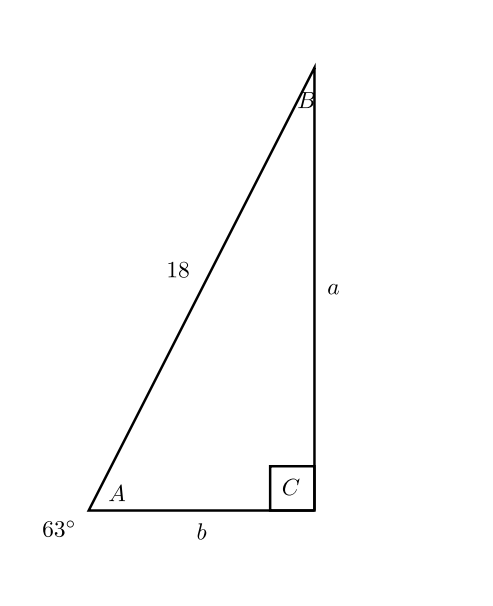
Identify the given side (hypotenuse) and angle. Choose the trigonometric ratio (sine) that relates the opposite side a, the hypotenuse, and the angle A.
Answer:
Step-by-Step Execution
- Identify the Given Information:
- Angle A=63∘
- Hypotenuse c=18
- Side a is opposite to angle A.
- Apply the Sine Ratio:
sin(A)=HypotenuseOpposite⟹sin(63∘)=18a
- Solve for a:
a=18⋅sin(63∘)≈18⋅0.8910065≈16.038⟹a≈16.04
Practice Problem 3
Express 127π rad in degrees. (Enter exact values.)
Multiply the radian value by the conversion factor π180∘.
Answer:
Step-by-Step Execution
Practice Problem 4
Express 23∘ in radians. (Enter exact values.)
Multiply the degree value by the conversion factor 180∘π.
Answer:
Step-by-Step Execution
Practice Problem 5
A wooden ramp is to be built with one end on the ground and the other end at the top of a short staircase. If the top of the staircase is 6 ft from the ground and the angle between the ground and the ramp is to be 26∘, how long does the ramp need to be? Round your answer to four decimal places.
Model the ramp as the hypotenuse of a right triangle. The height of the staircase (6 ft) is the opposite side to the angle 26∘.
Answer:
Step-by-Step Execution
- Apply the Sine Ratio:
sin(26∘)=x6⟹x=sin(26∘)6
- Calculate:
x≈0.4383716≈13.68703⟹x≈13.6870 ft
📅 Regroup 1
- Review unit circle quadrant signs and reference angles.
- Review radian-degree conversion factors.
Skill Block 2
Real-Life Engineering Applications
Spot Optimization (Chemical Engineering)
Continuous temperature monitoring in exothermic reactors is critical for safety. The temperature profile across reaction zones is modeled by piecewise functions, which must be continuous and differentiable to avoid physical discontinuities in heat transfer models.
An exothermic chemical reactor has a temperature profile along its central axis modeled by the piecewise function:
Determine the following:
- Find the values of a and b such that the temperature profile is continuous and differentiable at the boundary x=3 meters.
- Optimize the reactor design by finding the maximum temperature along the axis in the interval 0≤x≤5.
& Real-Life Application: Continuity and differentiability of thermal profiles prevent heat flux discontinuities in modeling. A smooth temperature transition ensures that the physical catalyst beds do not experience localized thermal shock, which could lead to reactor runaway.
💡 Show Worked Derivation
Continuous temperature monitoring in exothermic reactors is critical for safety. The temperature profile across reaction zones is modeled by piecewise functions, which must be continuous and differentiable to avoid physical discontinuities in heat transfer models.
An exothermic chemical reactor has a temperature profile along its central axis modeled by the piecewise function:
Determine the following:
- Find the values of a and b such that the temperature profile is continuous and differentiable at the boundary x=3 meters.
- Optimize the reactor design by finding the maximum temperature along the axis in the interval 0≤x≤5.
Step-by-Step Solution:
Find a and b for Continuity and Differentiability:
Continuity Condition: The left-hand limit must equal the right-hand limit at x=3:
x→3−lim(−x2+6x+80)=x→3+lim(ax+b)−32+6(3)+80=3a+b−9+18+80=3a+b⟹89=3a+b— (Equation 1)Differentiability Condition: The derivative from the left must equal the derivative from the right at x=3:
T′(x)={−2x+6a:0≤x<3:x>3x→3−lim(−2x+6)=x→3+lim(a)−2(3)+6=a⟹a=0Solve for b: Substitute a=0 into Equation 1:
89=3(0)+b⟹b=89So, the parameters are a=0 and b=89.
Find the Maximum Temperature on 0≤x≤5: With a=0 and b=89:
T(x)={−x2+6x+8089:0≤x<3:x≥3To find the maximum temperature:
- For 0≤x<3, find critical points of T(x)=−x2+6x+80:
T′(x)=−2x+6=0⟹x=3Since x=3 is the boundary, the function increases on [0,3) because T′(x)>0 for x<3.
- At x=0, T(0)=80∘C.
- For x≥3, the temperature is constant at T(x)=89∘C.
Therefore, the maximum temperature along the axis is 89∘C, reached at x≥3.
- For 0≤x<3, find critical points of T(x)=−x2+6x+80:
Calculus 1 Review (Limits, Continuity, & Derivatives)
General Overview
Skill Block 2 establishes fluency in limit evaluation, piecewise continuity/differentiability, curve sketching (concavity, inflection points), and optimization.
Conceptual Framework
- Indeterminate Limits: Resolving 00 limits using algebraic factoring or rationalizing.
- Continuity and Differentiability of Piecewise Functions: Ensuring a piecewise function is smooth at its boundary by setting the values and derivatives of each piece equal at that boundary.
- Second Derivative Tests: Concavity and inflection points are found using f′′(x).
- Applied Optimization: Formulating equations for a system under constraints and finding the extreme values using derivatives.
Key Equations & Structural Rules
- Continuity at x=c: limx→c−f(x)=limx→c+f(x)=f(c)
- Differentiability at x=c: limx→c−f′(x)=limx→c+f′(x)
- Optimization: Solve f′(x)=0 to find critical points.
Worked Example A: Algebraic Limit Evaluation
Evaluate the following limit:
💡 Reveal Worked Solution
- Check for Indeterminate Form: Substituting x=−2 gives 00.
- Factor Numerator and Denominator:
- Numerator: −x2+5x+14=−(x−7)(x+2)
- Denominator: −5x2−2x+16=(x+2)(−5x+8)
- Cancel Common Factor (x+2):
x→−2lim−5x+8−(x−7)
- Evaluate by Substitution:
−5(−2)+8−(−2−7)=189=21
Worked Example B: Piecewise Continuity and Differentiability
Find the values of a and b that make the following piecewise defined function both continuous and differentiable everywhere:
💡 Reveal Worked Solution
- Apply Continuity Condition at x=−3:
3(−3)+4=2(−3)2+a(−3)+b⟹−5=18−3a+b⟹−23=−3a+b— (Eq. 1)
- Apply Differentiability Condition at x=−3:
f′(x)={3,x<−3 4x+a,x>−33=4(−3)+a⟹3=−12+a⟹a=15
- Solve for b:
−23=−3(15)+b⟹−23=−45+b⟹b=22
Worked Example C: Norman Window Optimization
A Norman window is constructed by adjoining a semicircle to the top of a rectangular window. What is the maximum possible area, in square meters, of a Norman window with a perimeter of 26 meters?
💡 Reveal Worked Solution
- Set Up Perimeter and Area Equations:
Let the rectangle have width y and height x. The semicircle has radius r=y/2.
- Perimeter: P=2x+y+π(y/2)=26⟹2x=26−y(1+π/2)
- Area: A=xy+21π(y/2)2=xy+8πy2
- Substitute x to express A in terms of y:
A=y(13−2y−4πy)+8πy2=13y−2y2−8πy2=13y−y2(84+π)
- Maximize Area by Taking the Derivative:
dydA=13−y(44+π)=0⟹y=4+π52
- Calculate Maximum Area:
A=13(4+π52)−(4+π52)2(84+π)=4+π338 m2
Practice Problem 6: Concept & Reading Check
Open this Skill Block on the Memex to locate the information needed to answer the following:
- (a) Under the Conceptual Framework section, how do we ensure a piecewise function is continuous and differentiable at its boundary?
- (b) Look at Worked Example B. Explain why we set the derivatives of the two pieces equal to each other at x=−3 to find the value of a.
- (c) Trace Worked Example C. How is the perimeter equation used to express the window area in terms of a single variable y before maximizing?
Refer to the Conceptual Framework section (under continuity and differentiability conditions) and the solutions to Worked Examples B and C of this Skill Block on the Memex.
Answer: * (a) For continuity, set the function pieces equal at the boundary. For differentiability, set their derivatives equal at the boundary.
- (b) Since the function must be differentiable everywhere, the derivative from the left (f′(x)=3) must match the derivative from the right (f′(x)=4x+a) at x=−3, yielding 3=4(−3)+a.
- (c) The perimeter constraint (P=2x+y+π(y/2)=26) is solved to isolate x as a function of y, which is then substituted into the Area equation A=xy+πy2/8.
Step-by-Step Execution
- (a) As explained in the Conceptual Framework section, a piecewise function is continuous at a boundary point x=c if the left limit, right limit, and function value are all equal (limx→c−f(x)=limx→c+f(x)=f(c)). It is differentiable if the derivative limits match at the boundary (limx→c−f′(x)=limx→c+f′(x)).
- (b) In Worked Example B, the differentiability condition at the boundary x=−3 is applied. The derivative of the left piece is 3, and the derivative of the right piece is 4x+a. Setting them equal at x=−3 gives 3=4(−3)+a, which immediately isolates a=15.
- (c) Tracing Worked Example C, the window area depends on both x (height) and y (width). Using the perimeter constraint 2x+y+π(y/2)=26, we isolate 2x=26−y(1+π/2). Substituting this x into the area equation A=xy+8πy2 yields a single-variable quadratic function in terms of y, allowing us to find the maximum using single-variable calculus.
Practice Problem 7
Evaluate:
Substitute x=−5 to check for the indeterminate form 00. Rationalize the numerator by multiplying the numerator and denominator by the conjugate −x−2+3.
Answer:
Step-by-Step Execution
- Multiply by the Conjugate:
x→−5lim(−x−5)(−x−2+3)(−x−2−3)(−x−2+3)=x→−5lim(−x−5)(−x−2+3)−x−5
- Cancel Common Factor (−x−5) and Evaluate:
x→−5lim−x−2+31=3+31=231=63
Practice Problem 8
Consider a function f(x) with critical points at −2, −23, −53, and −21. Based on the sign table for f′(x) below, on which of the intervals is f(x) increasing?
| Interval | (−∞,−2) | (−2,−23) | (−23,−53) | (−53,−21) | (−21,∞) |
|---|---|---|---|---|---|
| Sign of f′(x) | + | − | + | + | + |
A function is increasing on an interval where its derivative is positive (f′(x)>0).
Answer:
Step-by-Step Execution
Read the table and select the intervals with a positive (+) derivative sign. All intervals except (−2,−23) have f′(x)>0, indicating the function is increasing.
Practice Problem 9
The graph of the derivative f′(x) is given below. On what interval(s) is the function f(x) concave up?
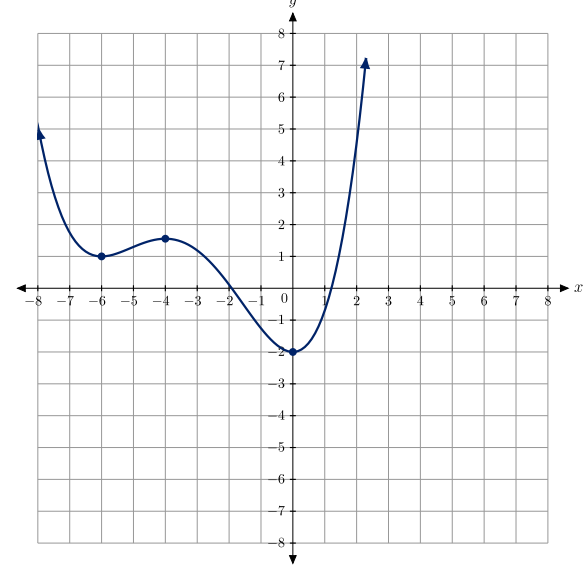
The function f(x) is concave up when its second derivative f′′(x)>0. On the graph of the first derivative f′(x), this corresponds to intervals where the slope of f′(x) is positive (i.e., where the graph of f′(x) is increasing).
Answer:
Step-by-Step Execution
Identify the intervals where the graph of f′(x) has a positive slope (is rising):
- Rising from x=−6 to x=−4
- Rising from x=0 to x=∞ Thus, the function f(x) is concave up on (−6,−4)∪(0,∞).
Practice Problem 10
Consider the function f(x)=4x5−7x3−5x+1. Find the x-values of all inflection points.
Find the second derivative f′′(x), set it to zero, and solve for x. Ensure that the sign of f′′(x) changes across these points.
Answer:
Step-by-Step Execution
- Find f′(x) and f′′(x):
f′(x)=20x4−21x2−5⟹f′′(x)=80x3−42x
- Solve f′′(x)=0:
2x(40x2−21)=0⟹x=0orx2=4021⟹x=±4021=±20210Since f′′(x) changes signs at each of these roots, they are all inflection points.
Practice Problem 11
Consider the function f(x)=4x4+322x3+2153x2+324x+3. Over what open interval(s) is the function increasing and concave up?
Find the intervals where f′(x)>0 (increasing) and f′′(x)>0 (concave up), then find the intersection of these intervals.
Answer:
Step-by-Step Execution
- Find Increasing Intervals (f′(x)>0):
f′(x)=x3+22x2+153x+324=(x+4)(x+9)2=0⟹Increasing on (−4,∞)
- Find Concave Up Intervals (f′′(x)>0):
f′′(x)=3x2+44x+153=(3x+17)(x+9)=0⟹Concave up on (−∞,−9)∪(−317,∞)
- Find the Intersection: The intersection of (−4,∞) and (−∞,−9)∪(−317,∞) is (−4,∞).
Practice Problem 12
A cell phone plan charges $30 per month for unlimited calls and texts, and each gigabyte (GB) of data is charged at $10 per GB (prorated). If a user uses more than 15 GB of data, the cost is capped at the cost for 15 GB. Write a piecewise-defined function for the cost C as a function of data d in GB.
For 0≤d≤15, the cost is the base fee plus $10 times d. For d>15, the cost is capped at the value of C(15).
Answer:
Step-by-Step Execution
- For 0≤d≤15: C(d)=30+10d
- For d>15: Cost is capped at C(15)=30+10(15)=180.
C(d)={30+10d,180,0≤d≤15d>15
📅 Regroup 2
- Review the definition of derivative, concavity, and critical points.
- Discuss standard optimization setup (objective function and constraint).
Skill Block 3
Real-Life Engineering Applications
Hydroelectric Reservoir Net Change (Civil & Environmental Engineering)
Tracking net water volume changes in hydroelectric reservoirs requires integrating the net flow rate (inflow minus spillway discharge) over an operational time period.
Water discharges through a spillway of a reservoir at a time-varying rate of r(t)=18−2t2 cubic meters per minute for t≥0, where t is measured in minutes. Initially, the reservoir has 65 cubic meters of active storage.
Determine the following:
- Write the definite integral representing the total volume of water discharged (lost) from the reservoir between t=0 and t=3 minutes.
- Evaluate this integral and determine how much water is remaining in the reservoir after 3 minutes.
& Real-Life Application: Applying the Net Change Theorem allows engineers to monitor reservoir reserves and predict power generation capacities. Integrating flow rates ensures that water levels remain above minimum hydraulic intake heights to prevent turbine cavitation.
💡 Show Worked Derivation
Tracking net water volume changes in hydroelectric reservoirs requires integrating the net flow rate (inflow minus spillway discharge) over an operational time period.
Water discharges through a spillway of a reservoir at a time-varying rate of r(t)=18−2t2 cubic meters per minute for t≥0, where t is measured in minutes. Initially, the reservoir has 65 cubic meters of active storage.
Determine the following:
- Write the definite integral representing the total volume of water discharged (lost) from the reservoir between t=0 and t=3 minutes.
- Evaluate this integral and determine how much water is remaining in the reservoir after 3 minutes.
Step-by-Step Solution:
Write the Definite Integral: The rate of water leaving the reservoir is given by r(t)=18−2t2. The total volume of water discharged over the interval [0,3] is the definite integral:
Volume Discharged=∫03(18−2t2)dtEvaluate the Integral and Calculate Remaining Water: First, find the antiderivative of the rate function:
∫(18−2t2)dt=18t−6t3Evaluate this antiderivative from t=0 to t=3:
[18(3)−633]−[18(0)−603]=[54−627]−0=54−4.5=49.5 cubic metersSubtract the discharged volume from the initial 65 cubic meters to find the remaining volume:
Volume Remaining=65−49.5=15.5 cubic meters
Calculus 2 Review (Integration & Net Change)
General Overview
Skill Block 3 covers definite integrals evaluated using geometric formulas, net signed area, and the Net Change Theorem.
Conceptual Framework
- Geometric Definite Integrals: Using known areas of circles, semicircles, triangles, and trapezoids to evaluate integrals without antiderivatives.
- Net Signed Area: Area above the x-axis is positive; area below is negative.
- The Net Change Theorem: The definite integral of a rate of change function F′(t) gives the total change in the quantity F(t) over that interval.
Key Equations & Structural Rules
- Semicircle Equation: y=R2−(x−x0)2⟹(x−x0)2+y2=R2
- Net Change Theorem: F(b)=F(a)+∫abF′(t)dt
Worked Example A: Geometric Definite Integral (Semicircle)
Evaluate the definite integral using geometric formulas:
💡 Reveal Worked Solution
- Identify the Curve: The integrand y=4−(x+5)2 represents a semicircle centered at (−5,0) with radius R=4=2, sitting above the x-axis.
- Check the Bounds: The bounds [−7,−3] represent the full domain of the semicircle (from −5−2 to −5+2).
- Calculate Semicircle Area:
Area=21πR2=21π(2)2=2π
Worked Example B: Net Signed Area
Find the net signed area between the graph of f(x)=4−45x and the x-axis over the interval [56,546].
💡 Reveal Worked Solution
- Set Up the Definite Integral:
Net Signed Area=∫6/546/5(4−45x)dx
- Find the Antiderivative:
F(x)=4x−85x2
- Evaluate at the Bounds:
- Upper bound: F(46/5)=4(46/5)−85(46/5)2=5184−10529=−10161
- Lower bound: F(6/5)=4(6/5)−85(6/5)2=524−109=1039
- Subtract:
Net Signed Area=−10161−1039=−10200=−20
Worked Example C: Net Change from a Graph
A function F(x) has an initial value F(0)=−1. The graph of its derivative F′(x) is a line passing through (0,0) with a constant slope of −2. What is the value of F(3)?
💡 Reveal Worked Solution
- Apply the Net Change Theorem:
F(3)=F(0)+∫03F′(x)dx
- Calculate the Area under F′(x) Geometrically:
From x=0 to x=3, the graph of F′(x)=−2x forms a right triangle below the x-axis.
- Base = 3
- Height = F′(3)=−6⟹ vertical length is 6.
- Area (below x-axis) = −21×3×6=−9.
- Solve for F(3):
F(3)=−1+(−9)=−10
Practice Problem 13: Concept & Reading Check
Open this Skill Block on the Memex to locate the information needed to answer the following:
- (a) Under the Conceptual Framework section, what is the difference between net signed area and total area when evaluating definite integrals?
- (b) According to the Key Equations & Structural Rules section, how is the accumulated quantity F(b) computed from the initial value F(a) and the rate of change F′(t)?
- (c) Trace Worked Example A. Describe the geometric shape represented by the integrand y=−(x+5)2+4, including its center and radius.
Refer to the Conceptual Framework (under Net Signed Area), the Key Equations & Structural Rules (under Net Change Theorem), and the solution to Worked Example A of this Skill Block on the Memex.
Answer: * (a) Net signed area treats area above the axis as positive and below as negative. Total area treats all bounded regions as strictly positive.
- (b) F(b)=F(a)+∫abF′(t)dt.
- (c) It is a semicircle centered at (−5,0) with a radius of 2, positioned above the x-axis.
Step-by-Step Execution
- (a) As outlined in the Conceptual Framework section, when evaluating an integral, net signed area subtracts regions below the x-axis from regions above, whereas total area takes the absolute value of all regions so they are all added positively.
- (b) The Net Change Theorem formula in the Key Equations & Structural Rules section states that the final value F(b) equals the initial value F(a) plus the net accumulated change, which is the definite integral of the rate function F′(t) from a to b.
- (c) Tracing the solution to Worked Example A, the equation of the curve is y=4−(x+5)2. Squaring both sides and rearranging yields (x+5)2+y2=22 (with y≥0), which represents a semicircle sitting above the x-axis, centered at (−5,0) with a radius of 2.
Practice Problem 14
Evaluate the definite integral using geometric formulas:
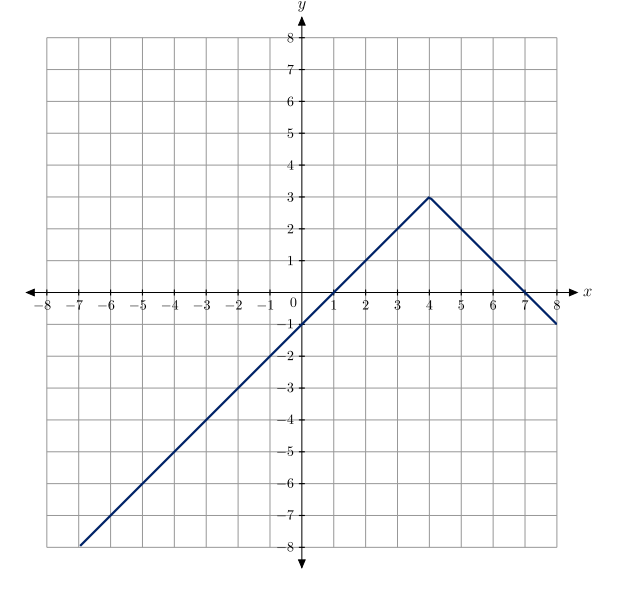
Identify the shape under the curve. The absolute value function creates a triangular region. Find the base and height of this triangle.
Answer:
Step-by-Step Execution
- Find Triangle Dimensions:
- Base: from x=1 to x=7⟹b=6.
- Height: peak is at x=4⟹h=f(4)=3−0=3.
- Calculate Area:
Area=21×6×3=9
Practice Problem 15
The piecewise function f(x) is graphed below. Use geometric formulas to find the total area between the graph of the function and the x-axis.
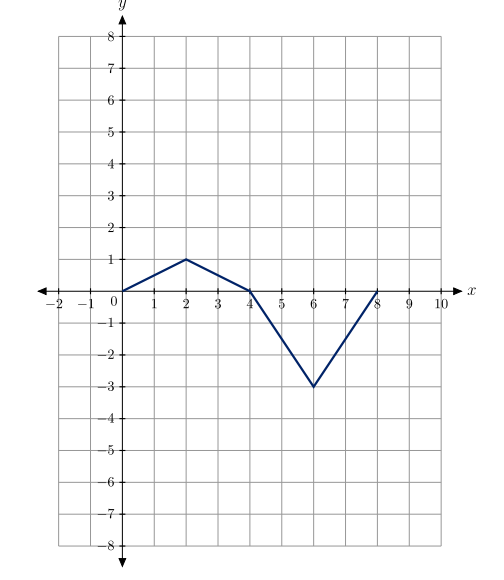
"Total Area" treats all bounded regions as positive. Split the shape into two triangles: one above the x-axis ([0,4]) and one below ([4,8]).
Answer:
Step-by-Step Execution
- Calculate Area of Triangle 1 (above axis):
- Base b1=4, Height h1=1⟹A1=21×4×1=2
- Calculate Area of Triangle 2 (below axis):
- Base b2=4, Height h2=3⟹A2=21×4×3=6
- Sum the Areas:
Total Area=A1+A2=2+6=8
Practice Problem 16
Water leaks out of a tank at a rate of r(t)=18−2t2 for t≥0, measured in gallons per minute. Initially the tank has 65 gallons of water in the tank. How much water is left in the tank after 3 minutes?
The total water lost is the integral of the rate function ∫03r(t)dt. Subtract this lost volume from the initial volume.
Answer:
Step-by-Step Execution
- Set Up the Equation:
Water Left=65−∫03(18−2t2)dt
- Integrate:
∫03(18−2t2)dt=[18t−6t3]03=18(3)−627=54−4.5=49.5 gallons lost
- Subtract:
Remaining Water=65−49.5=15.5 gallons
📅 Regroup 3
- Discuss the difference between net signed area and total area.
- Review the Net Change Theorem.
📅 Synthesis Wrap-up
- Re-emphasize key calculus prerequisites.
- Discuss how limits, derivatives, optimization, and integration are generalized to multi-dimensional surfaces in Calculus 3.