Did you know that if there are two forces pulling in different directions on an object, the object behaves the same as though it were acted on by one single force that is the vector sum of the two?
Concept Explanation
In physics and engineering, this is known as the principle of superposition of forces. Instead of tracking multiple individual forces pulling in different directions, we can combine (or compose) them into a single equivalent force called the resultant force ().
Mathematically, the resultant force is the vector sum of all individual forces:
Geometrically, this is represented by placing the force vectors head-to-tail. The vector connecting the initial tail to the final head is the resultant force vector.
Visualizing the Principle (Equivalent Systems)
This comic strip shows how two separate forces acting on a block are equivalent to a single resultant force vector:
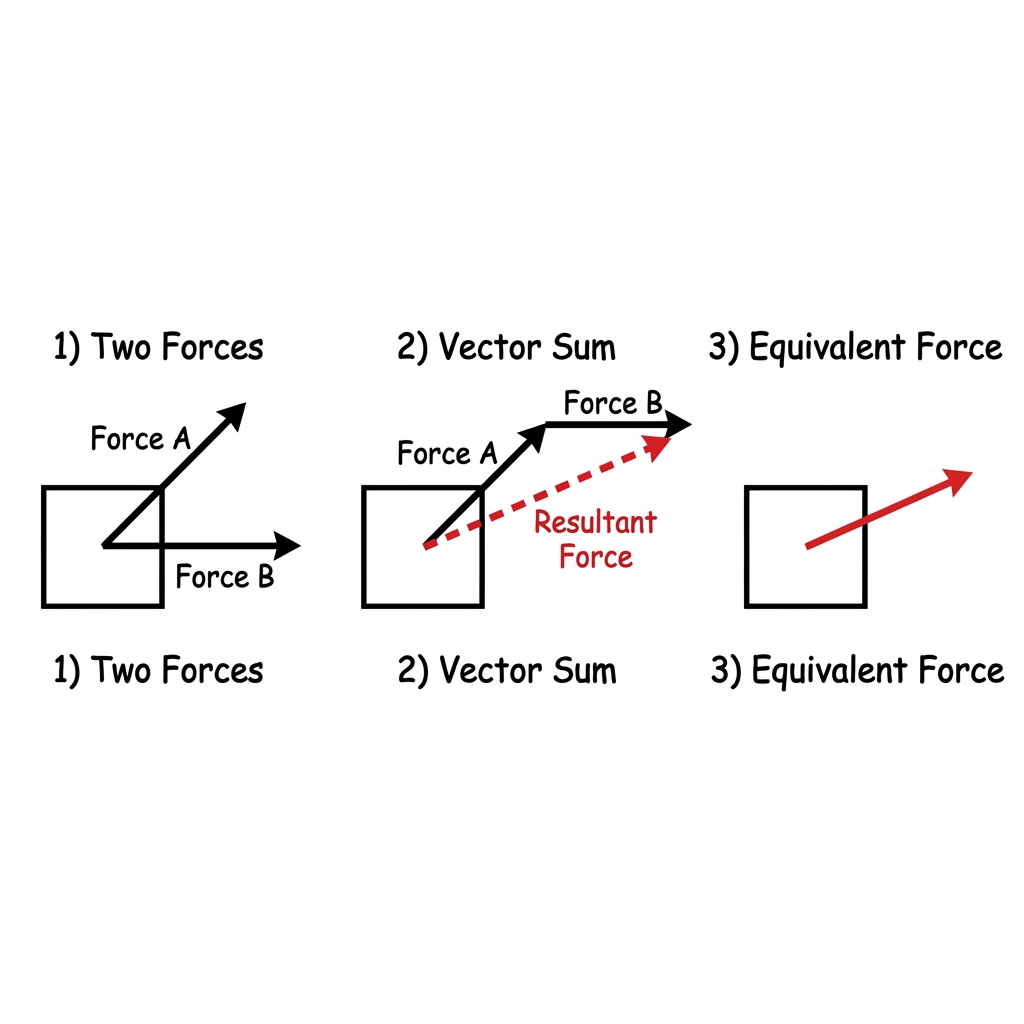
- Two Forces: Two separate ropes pull the block in different directions (Force A up-right at , Force B horizontally to the right).
- Vector Sum: Geometrically adding Force A and Force B head-to-tail (by shifting Force B to start at the tip of Force A) reveals the dashed red Resultant Force vector pointing diagonally up-right at a shallower angle.
- Equivalent Force: Actuating the block with only a single rope pulled with the resultant force vector produces the exact same physical acceleration and motion.
Engineering Applications
- Structural Foundations: Designing columns or footings by combining various dead loads (weight of structure), live loads (inhabitants), and wind loads into a single resultant load vector.
- Aircraft Propulsion: Combining the thrust vectors of multiple jet engines to find the overall thrust vector acting on the aircraft.
- Tugboat Navigation: Coordinating two tugboats pulling a large ship at different angles to steer the ship in a single desired resultant direction.
Example Problem
A metal bracket is subjected to two forces: and . Find the equivalent single combining force that would produce the same physical effect on the bracket.
Solution
Step 1: Apply the superposition principle Add the component vectors of and :
Step 2: Substitute components
Step 3: State the equivalent force Actuating the bracket with a single force vector of is physically identical to the simultaneous action of both and .
Connections & References
- Parent Concepts: Vectors
- Sub-concepts: Force Components
- Course Links: Calc-3 Session 02