Core Definition
If a real-valued function is continuous on a closed interval , then is guaranteed to attain both an absolute maximum value and an absolute minimum value at least once within :
Here, is the absolute minimum value and is the absolute maximum value.
Concept Explanation
1. The Two Pillars of the Hypothesis
The Extreme Value Theorem (EVT) is an existence theorem that guarantees optimal physical solutions exist before executing algebraic computations.
To apply the EVT, two preconditions must be met simultaneously:
- Hypothesis 1: Continuity: The function must be continuous at every point in the interval (no vertical asymptotes, holes, or finite jump discontinuities).
- Hypothesis 2: Closed Interval: The domain must explicitly include both boundary endpoints, represented with square brackets (or ).
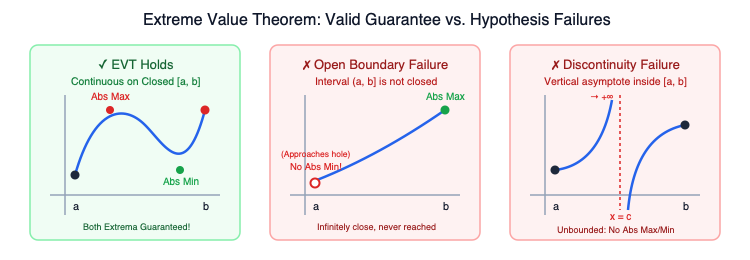
2. Diagnostic Hypothesis Testing: When the Hypotheses Fail
If either condition fails, the EVT is neutralized. This does not prove that extrema cannot exist; it means their existence is no longer guaranteed.
- Open Boundary Violation: Consider on the half-open interval .
- The function is continuous, but the boundary is excluded.
- As , , but is never achieved because .
- The function attains an absolute maximum of at , but has no absolute minimum.
- Discontinuity Violation: Consider on .
- The interval is closed, but has an infinite discontinuity (vertical asymptote) at .
- As , ; as , .
- The function is unbounded, so neither an absolute maximum nor an absolute minimum exists.
Engineering Applications
- Civil Structural Design Safety Audits: Before designing reinforced concrete pillars or steel bridge spans, structural engineering codes mandate proving that load-displacement functions are continuous over the closed span . The EVT guarantees that peak tensile stress occurs at some physical cross-section within the span, ensuring the safety factor calculation is mathematically robust.
- Aerospace Thermal Heat Shield Sizing: During planetary atmospheric entry, spacecraft heat shield surface temperature evolves over a closed mission window . Continuity of thermodynamic heat transfer ensures that a true peak surface temperature exists, enabling material scientists to select appropriate ablative carbon tile thickness.
- Power Grid Voltage Regulation: High-voltage transmission lines experience line impedance variations over daily load cycles . Continuous load profiles guarantee peak power dissipation instants, allowing grid operators to size step-up substation transformers without risk of unmodeled thermal overload.
Example Problems
Example 1: Testing the Continuity Hypothesis
Determine if the Extreme Value Theorem applies to on the interval . If not, state the violated hypothesis.
Solution
- Check Interval Type: The interval includes its endpoints, so it satisfies the closed interval hypothesis.
- Check Continuity: The rational function is undefined where the denominator equals zero:
Since is a zero of the denominator (and not of the numerator), has an infinite discontinuity (vertical asymptote) at .
- Interval Intersection: Because , the function fails the continuity hypothesis on the interval.
- Conclusion: The Extreme Value Theorem does not apply because is not continuous on (violation at ).
Example 2: Testing the Boundary Hypothesis
Determine if the Extreme Value Theorem applies to on the interval . If not, state the violated hypothesis.
Solution
- Check Continuity: As a polynomial, is continuous on all real numbers . Therefore, it is continuous on .
- Check Interval Type: The left endpoint at is marked by a parenthesis, indicating an open boundary ().
- Conclusion: The Extreme Value Theorem does not apply because the interval is not closed. The existence of an absolute minimum is not guaranteed.
Connections & References
- Parent Concept: Intermediate Value Theorem
- Operational Procedure: Closed Interval Method
- Related Notes:
- Course Sessions: