Core Definition
The Closed Interval Method is an exact analytical algorithm used to locate the absolute maximum and absolute minimum values of a continuous function on a closed interval . Because absolute extrema can occur only at interior critical numbers or at boundary endpoints, the method evaluates the original function across all candidate points and directly compares their heights (-values).
Concept Explanation
1. The 5-Step Closed Interval Method Pipeline
When a function satisfies the preconditions of the Extreme Value Theorem, execute the following 5-step pipeline:
Step 1: Check Preconditions (Continuity on [a, b])
                  |
Step 2: Differentiate (Compute f'(x))
                  |
Step 3: Find & Filter Interior Critical Numbers (c in (a, b) where f'(c)=0 or DNE)
                  |
Step 4: Evaluate Original Function f(x) at:
        - Surviving interior critical numbers: f(c_1), f(c_2), ...
        - Left boundary endpoint: f(a)
        - Right boundary endpoint: f(b)
                  |
Step 5: Compare Heights:
        - Highest value  --> Absolute Maximum Value
        - Lowest value   --> Absolute Minimum Value
2. Common Pitfalls to Avoid
- Pitfall 1: The Derivative Evaluation Trap: Never substitute candidate points back into the derivative . Substituting critical numbers into yields or undefined. Always evaluate the original function to find the physical heights (-values).
- Pitfall 2: Forgetting Endpoints: Absolute extrema frequently occur at the boundaries or , where . Neglecting endpoint evaluations can cause you to miss the true global maximum or minimum.
- Pitfall 3: Failing to Filter Candidates: Only critical numbers located strictly inside the open interval are valid candidates. Any solutions to outside must be discarded.
- Pitfall 4: Overlooking Singular Points (): Always check whether the denominator of can equal zero within (e.g., fractional exponents such as or ).
Engineering Applications
- Civil Structural Beam Bending Moments: Reinforced concrete bridge beams spanning experience internal bending moment distributions . Civil engineers use the Closed Interval Method to compare moments at support piers () against internal critical moment sections (), ensuring rebar steel reinforcement is placed at the absolute peak bending stress location.
- Transistor Thermal Duty-Cycle Analysis: Power semiconductor devices (such as GaN MOSFETs) experience thermal junction heating over a periodic switching cycle . Electronic systems engineers apply the Closed Interval Method to verify that the absolute peak junction temperature does not breach the silicon thermal damage ceiling.
- Subsea Pipeline Pressure Cycling: Marine petroleum pipelines spanning a seabed elevation profile over total pipeline length must withstand hydrostatic burst pressure. Engineers evaluate pipeline wall stresses at intermediate high/low points and boundary manifolds using closed-interval optimization.
Example Problems
Example 1: Polynomial on a Closed Interval
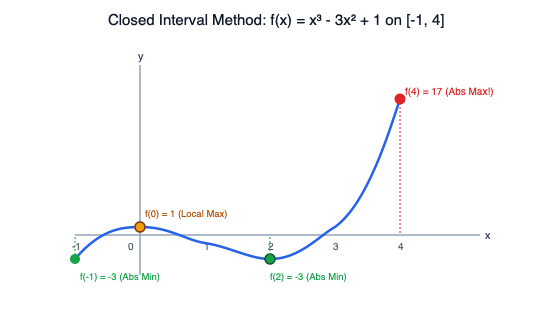
Find the absolute maximum and minimum values of on the closed interval :
Solution
- Check Continuity: is a polynomial, so it is continuous on . The EVT applies.
- Differentiate:
- Locate and Filter Critical Numbers:
Set :
Filter: Both and lie strictly inside the interior interval . Both are retained.
- Evaluate Original Function at All Candidates:
- Left Endpoint ():
- First Critical Number ():
- Second Critical Number ():
- Right Endpoint ():
- Left Endpoint ():
- Compare and Conclude:
- Absolute Maximum Value: at location .
- Absolute Minimum Value: at locations and .
Example 2: Function with a Cusp on a Closed Interval
Find the absolute extrema of on :
Solution
- Check Continuity: is continuous everywhere, including on .
- Differentiate:
- Find Critical Numbers:
- Stationary Points (): Numerator equals zero:
- Singular Points (): Denominator equals zero:
- Filter: Both and lie in .
- Stationary Points (): Numerator equals zero:
- Evaluate Original Function :
- Left Endpoint ():
- Singular Point ():
- Stationary Point ():
- Right Endpoint ():
- Compare and Conclude:
- Absolute Maximum Value: at location .
- Absolute Minimum Value: at location .
Connections & References
- Theoretical Basis:
- Alternative/Related Tests:
- Course Sessions: