Let be a critical number of a continuous function on an open interval :
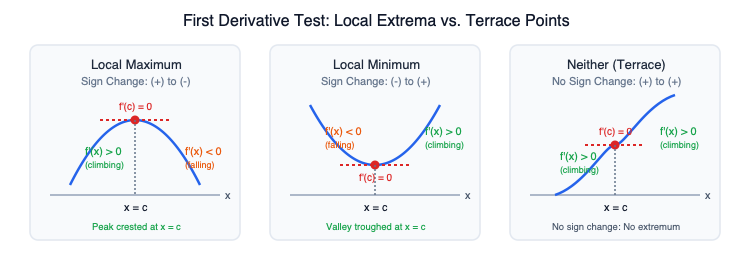
- Local Maximum: If changes sign from positive to negative () as increases through , then is a local (relative) maximum.
- Local Minimum: If changes sign from negative to positive () as increases through , then is a local (relative) minimum.
- Neither (Terrace / Inflection): If has the same sign on both sides of ( or ), then is neither a local maximum nor a local minimum.
Concept Explanation
1. The Monotonicity Test
The First Derivative Test is grounded in the Monotonicity Theorem (a direct consequence of the Mean Value Theorem):
- If on an interval, then the tangent slopes are positive, meaning is strictly increasing ().
- If on an interval, then the tangent slopes are negative, meaning is strictly decreasing ().
When a function switches from climbing () to descending (), it naturally crests at a local summit (peak). When it switches from descending () to climbing (), it troughs at a local valley.
2. Standard 4-Step Sign Analysis Workflow
To classify critical numbers systematically using a 1D Sign Chart:
- Differentiate & Locate Critical Numbers: Find and determine all numbers where or is undefined.
- Partition the Number Line: Place all critical numbers (along with any domain discontinuities, such as vertical asymptotes) on a horizontal axis to partition the domain into disjoint open test intervals.
- Select Test Values: Choose one convenient test point strictly within each test sub-interval.
- Evaluate the Sign in the Derivative: Substitute each test point strictly into (never into ). Record solely the algebraic sign ( or ):
- , function is increasing.
- , function is decreasing.
Sign Chart Schema:
Interval:     (-inf, c1)  |  (c1, c2)   |  (c2, inf)
Test Point:       k1      |     k2      |     k3
Sign of f'(x):    (+)     |    (-)      |    (+)
Behavior:      Increasing | Decreasing  | Increasing
                  \            /            /
                   \          /            /
                  Local Max at c1      Local Min at c2
3. The Single Critical Point Rule for Absolute Extrema
When optimizing a function over an open or unbounded interval (such as or ), the Closed Interval Method cannot be used because boundary endpoints do not exist. However:
If is continuous on an interval and contains exactly one critical number :
- If is a local minimum, then is automatically the absolute minimum of on .
- If is a local maximum, then is automatically the absolute maximum of on .
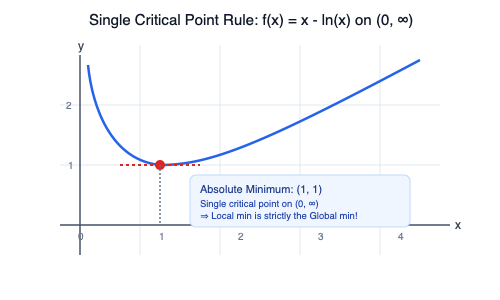
Because there are no other turning points or asymptotes to reverse the direction of the curve, the local extremum must be globally supreme across the entire domain.
Engineering Applications
- Chemical Bioreactor Dissolved Oxygen Regulation: In aerobic bioprocess engineering, the dissolved oxygen saturation curve rises as aeration pumps start, peaks at optimal microbial metabolic consumption, and slowly levels out. Engineers use the First Derivative Test to establish the single global peak of the oxygen profile and calibrate compressor duty cycles.
- Aerospace Dynamic Pressure (-Max): During orbital launch, a rocket's dynamic aerodynamic pressure begins at zero, climbs rapidly as airspeed increases, and then drops as the vehicle exits the dense lower atmosphere. Finding the single critical point where identifies Max-Q—the instant of peak structural load on the rocket airframe.
- Acoustic Speaker Enclosure Tuning: The resonant efficiency of a ported bass-reflex loudspeaker enclosure depends on port air velocity. Audio engineers use sign testing to pinpoint the Helmholtz frequency where port acoustic impedance reaches a local minimum, ensuring clean low-frequency bass extension.
Example Problems
Example 1: Sign Chart on an Unbounded Interval
Find and classify all local and absolute extrema of on its natural domain :
Solution
- Differentiate:
- Critical Numbers:
- .
- is undefined at , but .
- Thus, is the sole critical number in the domain.
- Sign Chart around on :
- Interval : Test . Function is decreasing.
- Interval : Test . Function is increasing.
- Classification & Single Critical Point Rule:
- Since transitions from negative to positive () at , is a local minimum.
- Because is the only critical number in the entire open interval , it is guaranteed to be the absolute minimum:
- Absolute Minimum Value: at location .
- Absolute Maximum: Does not exist (the function grows to as and ).
Example 2: Polynomial with Terrace Point
Find and classify all critical points of on :
Solution
- Differentiate:
- Find Critical Numbers:
- Construct Sign Chart:
Critical points divide into , , and . Note that the factor for all , so the sign of is dictated entirely by :
- Interval : Test . Decreasing.
- Interval : Test . Decreasing.
- Interval : Test . Increasing.
- Classification:
- At : does not change sign (remains negative on both sides). Thus, is a terrace point (horizontal inflection), neither a maximum nor a minimum.
- At : changes sign from negative to positive (). Thus, is a local minimum:
- Since , at is also the absolute minimum. No absolute maximum exists.
Connections & References
- Parent Concepts:
- Related Optimization Techniques:
- Course Sessions: